5.4.2 Quiz Module 5: Risk Assessment Answers
5.4.2 Quiz Module 5: Risk Assessment Answers
The 5.4.2 Quiz Module 5: Risk Assessment Answers provide the correct answers to questions focused on identifying, analyzing, and evaluating cybersecurity risks. These answers help learners review key concepts such as assets, threats, vulnerabilities, likelihood, impact, risk levels, mitigation strategies, and the overall risk assessment process. By studying the Module 5 Risk Assessment Answers, learners can strengthen their understanding of how organizations identify and manage security risks and prepare more confidently for the quiz and related assessments.
-
What do Impact Metrics, in the Base Metric Group of the Common Vulnerability Scoring System (CVSS), primarily assess?
- the likelihood of a successful attack on the vulnerable system
- the predicted effects and consequences of a successful exploit of a vulnerability
- the cost associated with implementing security measures to prevent exploits
- the financial implications and potential expenditures that an organization may incur as a result of implementing necessary security measures to safeguard against vulnerabilities
-
What is the primary purpose of threat modeling in the context of system and software security?
- To conduct a one-time assessment of vulnerabilities and risks before system deployment.
- To integrate vulnerability and risk assessments through the system design and production lifecycle.
- To replace traditional security measures with a new framework of compliance standards.
- To focus solely on identifying potential security threats without considering their impact on the system.
-
What is the initial step in the threat modeling process?
- Identifying potential risks and their impacts on the system.
- Evaluating whether the threats have been effectively addressed.
- Conducting a comprehensive security audit of the deployed system to mitigate risks.
- Understanding the system by answering key questions about threats and risks.
-
Match each impact of compromised IACS systems with the correct consequence.
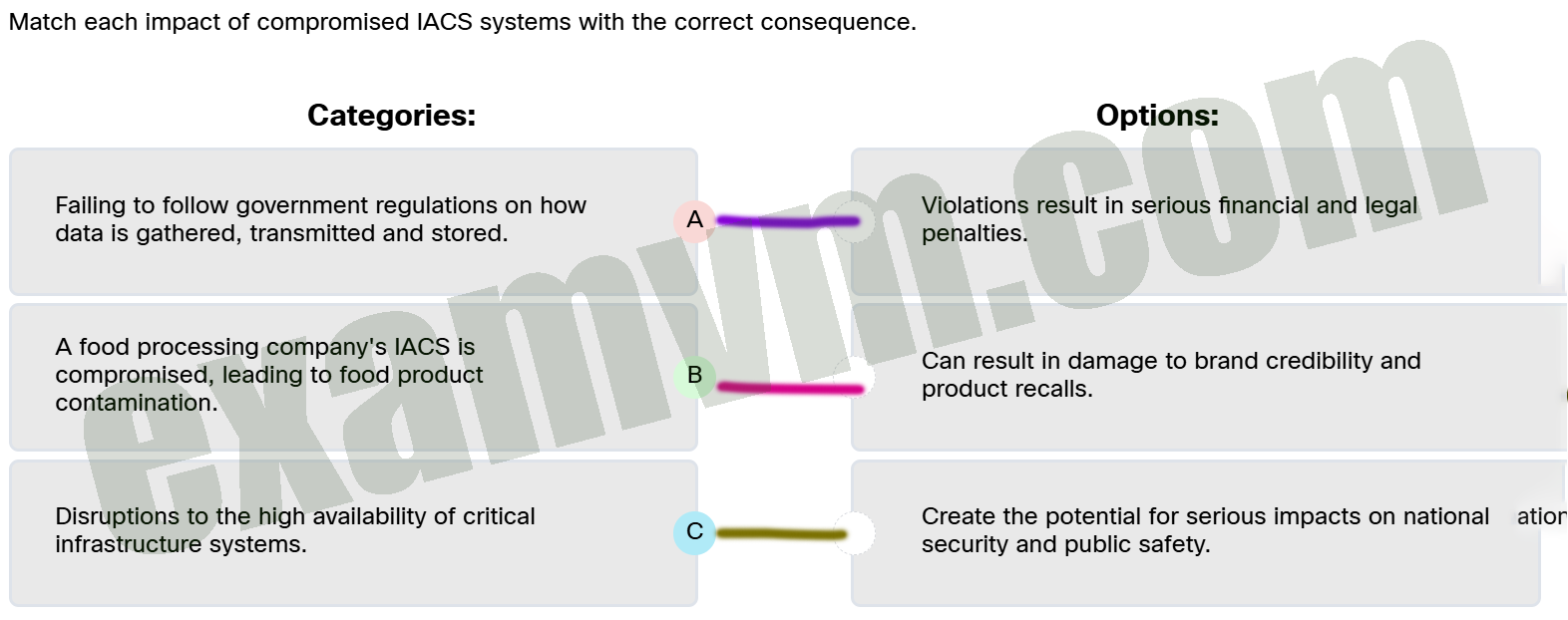
Match each impact of compromised IACS systems with the correct consequence - Failing to follow government regulations on how data is gathered, transmitted and stored. ==> Violations result in serious financial and legal penalties.
- A food processing company’s IACS is compromised, leading to food product contamination. ==> Can result in damage to brand credibility and product recalls.
- Disruptions to the high availability of critical infrastructure systems. ==> Create the potential for serious impacts on national security and public safety.
-
What is a new challenge presented by Industrial Operational Technology (OT) networks that differs from traditional IT networks?
- increased need for faster data processing speeds
- need for more encryption protocols for financial transactions
- scale of attacks enabled by the Industrial Internet of Things (IIoT) and the connectivity of critical infrastructure
- rise of widespread Distributed Denial of Service (DDoS) attacks and the connectivity of critical infrastructure
-
Which three questions are typically addressed during a risk assessment process? (Choose three.)
- When will the attacks occur and why?
- What vulnerabilities can threat actors exploit?
- Who are the threat actors who want to attack us?
- What is the budget for our cybersecurity program?
- What technologies can we adopt to boost productivity?
- How would the organization be affected by successful attacks?
-
Which components are commonly included in an IACS data flow diagram (DFD)?
- local applications, OT network gateways, and control applications
- physical security measures and fire suppression systems
- network firewalls, intrusion detection systems, and virtual private networks
- user training programs and documentation for operational procedures
-
How are devices represented in most Data Flow Diagrams (DFDs)?
- DFDs use specific symbols for different device functions.
- DFDs typically use topology icons for all components.
- DFDs represent devices solely through textual descriptions and annotations.
- DFDs exclusively utilize color coding to differentiate between device types.
-
What is the purpose of trust boundaries in systems architecture?
- To define areas where the level of trust between entities is consistently the same.
- To indicate sections of the network where the levels of trust are different in the data flow.
- To limit the number of users who can access the system architecture.
- To represent the physical locations of servers and devices in the network.
-
Which statement describes a characteristic of trust boundaries?
- Data can flow freely without authentication between all devices within a trust boundary.
- The IoT Gateway and Cloud Gateway represent two entities that cross a trust boundary.
- Trust boundaries are only applicable to physical devices, not to data flows.
- Trust boundaries eliminate the need for authorization in data traffic.
-
Match components of the IEC 62443-3 risk assessment process to the description.
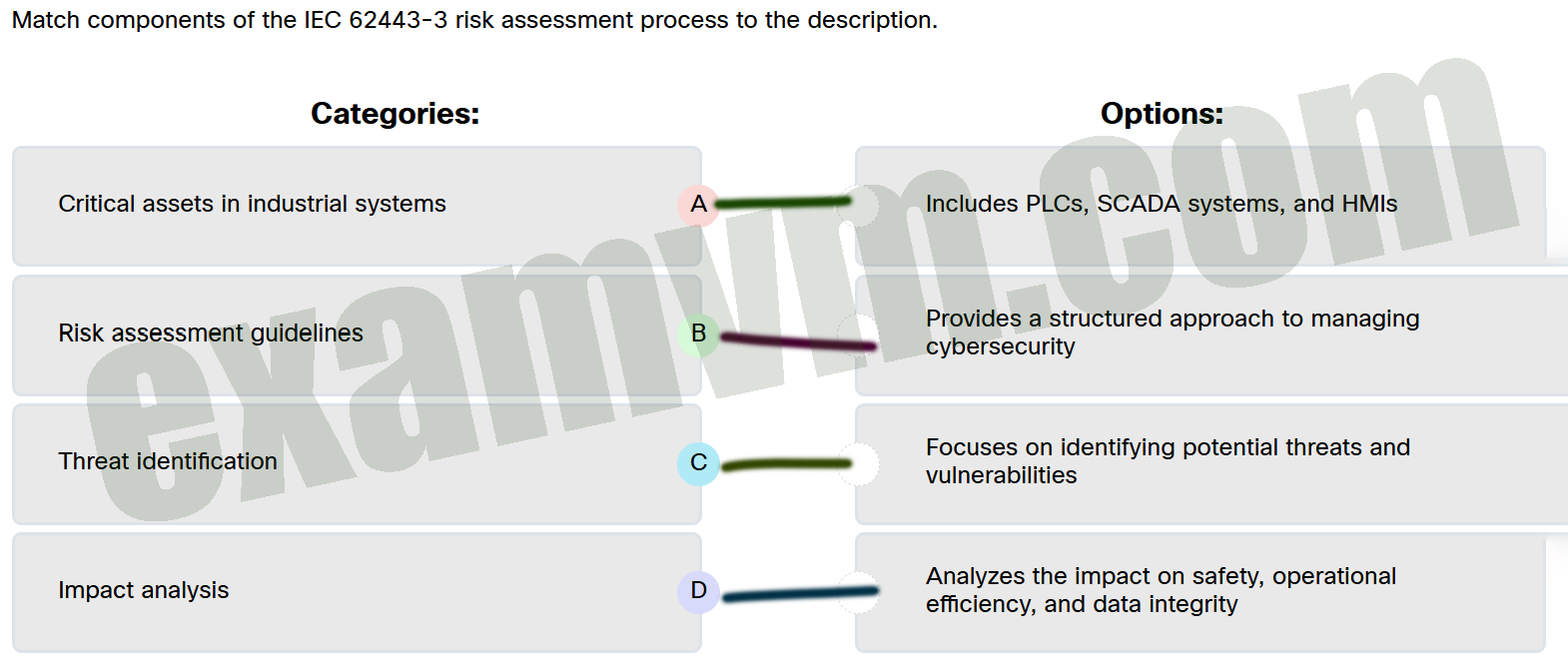
Match components of the IEC 62443-3 risk assessment process to the description - Critical assets in industrial systems ==> Includes PLCs, SCADA systems, and HMIs
- Risk assessment guidelines ==> Provides a structured approach to managing cybersecurity
- Threat identification ==> Focuses on identifying potential threats and vulnerabilities
- Impact analysis ==> Analyzes the impact on safety, operational efficiency, and data integrity
-
Which three processes are essential steps in a comprehensive risk assessment approach for cybersecurity in industrial environments? (Choose three.)
- Threat identification
- Vulnerability assessment
- Marketing strategies
- Asset identification and valuation
- Market research for new products
- Engagement strategies for social media
-
What does the Base Metric Group in the Common Vulnerability Scoring System (CVSS) represent?
- a score that varies depending on the organization’s security policies
- a metric group specifically designed for evaluating environmental impacts
- a score based on user feedback and community input regarding vulnerabilities
- an applicable score created by analyzing vulnerabilities
-
Match CVSS Metric Group to the description.
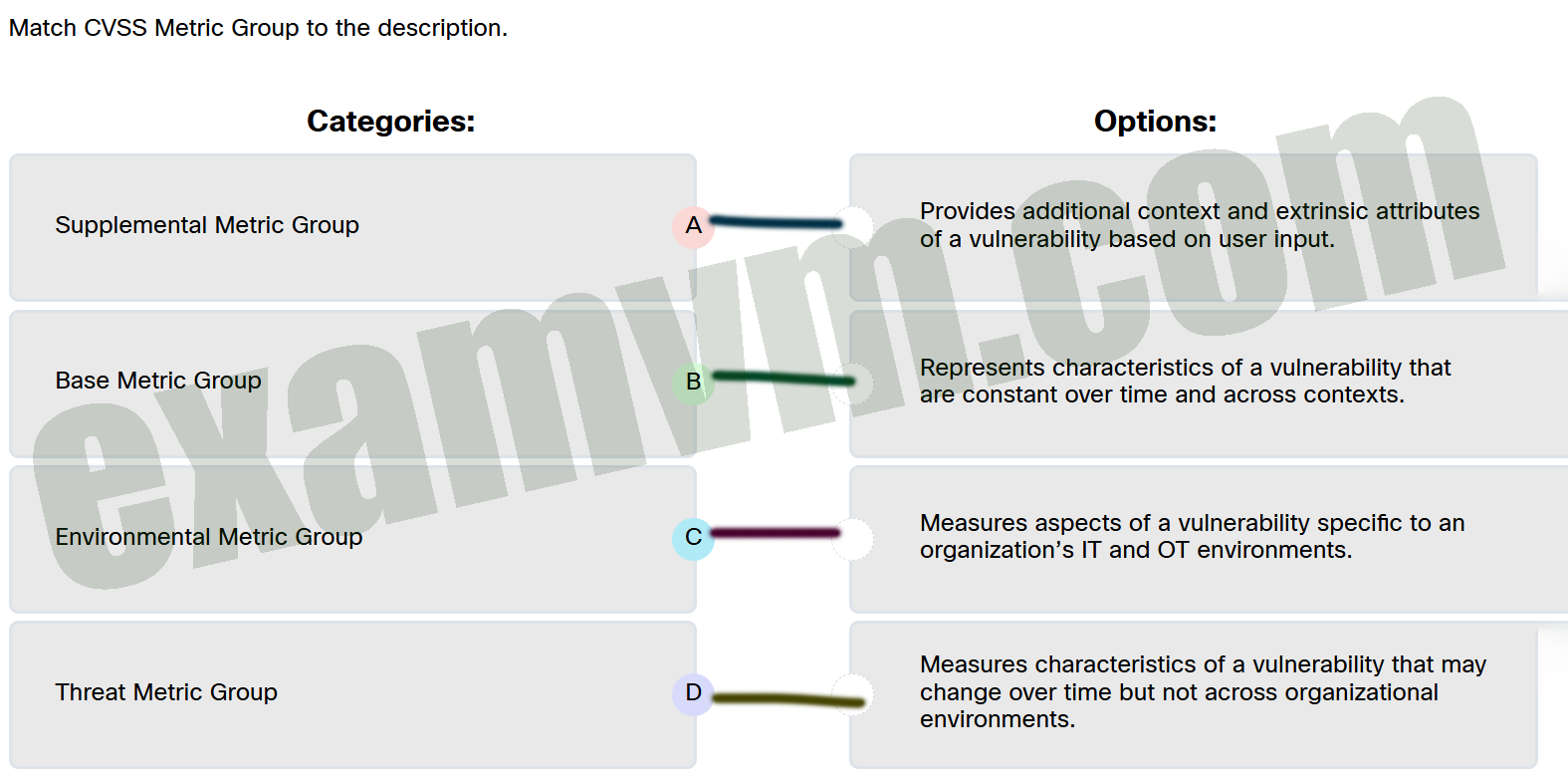
Match CVSS Metric Group to the description - Supplemental Metric Group ==> Provides additional context and extrinsic attributes of a vulnerability based on user input.
- Base Metric Group ==> Represents characteristics of a vulnerability that are constant over time and across contexts.
- Environmental Metric Group ==> Measures aspects of a vulnerability specific to an organization’s IT and OT environments.
- Threat Metric Group ==> Measures characteristics of a vulnerability that may change over time but not across organizational environments.
-
Match the reason for updating the Common Vulnerability Scoring System (CVSS) to the description.
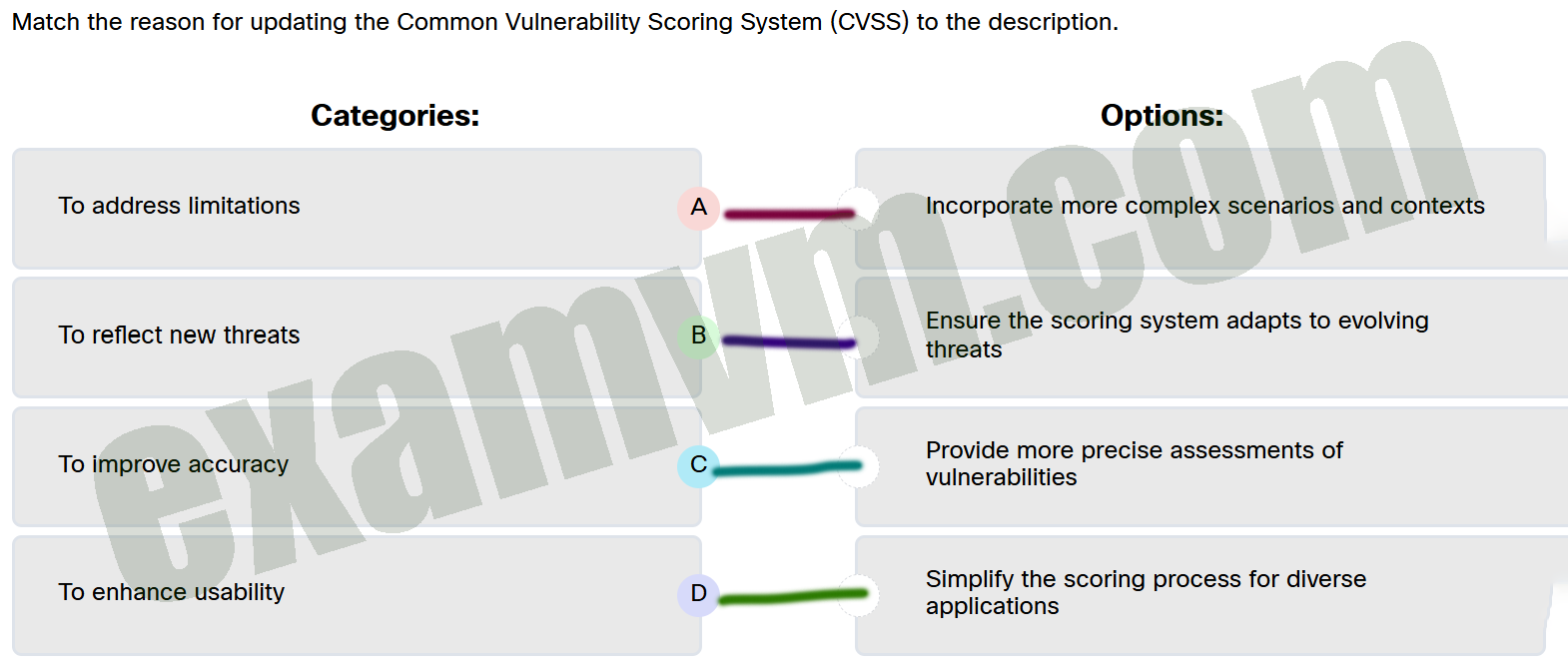
Match the reason for updating the Common Vulnerability Scoring System (CVSS) to the description - To address limitations ==> Incorporate more complex scenarios and contexts
- To reflect new threats ==> Ensure the scoring system adapts to evolving threats
- To improve accuracy ==> Provide more precise assessments of vulnerabilities
- To enhance usability ==> Simplify the scoring process for diverse applications