8.3.2 Quiz Module 8: Hardening the Industrial Network Infrastructure Answers
8.3.2 Quiz Module 8: Hardening the Industrial Network Infrastructure Answers
The 8.3.2 Quiz Module 8: Hardening the Industrial Network Infrastructure Answers provide the correct answers to questions focused on strengthening the security of industrial network infrastructure. These answers help learners review key concepts such as secure device configuration, network segmentation, patch management, access control, disabling unnecessary services, protecting network devices, monitoring, and applying defense-in-depth strategies. By studying the Module 8 Hardening the Industrial Network Infrastructure Answers, learners can reinforce their understanding of industrial network security and prepare more confidently for the quiz and related assessments.
-
What mitigation plan is best for thwarting a DoS attack that is creating a MAC address table overflow?
- Disable DTP.
- Disable STP.
- Enable port security.
- Place unused ports in an unused VLAN.
-
Why is it important to monitor CPU and memory resource usage on network devices?
- Monitoring CPU and memory resource usage helps to detect and mitigate potential DoS attack vectors.
- Monitoring CPU and memory resources identifies communications received that are not encrypted therefore require more bandwidth.
- Monitoring CPU usage is enough, as memory usage does not contribute to network device performance issues.
- Cisco IOS Software automatically mitigates low-memory and high-CPU usage without needing any notifications or thresholds.
-
What is the primary reason for encrypting traffic during an interactive management session?
- To prevent unauthorized users from capturing sensitive data transmitted during the session.
- To ensure that all devices on the network can communicate without any restrictions, regardless of their security status.
- To increase the speed of data transmission between devices by reducing overhead associated with security measures.
- To allow administrators to access devices remotely without any extra authentication requirements.
-
Match the functional planes to the descriptions.
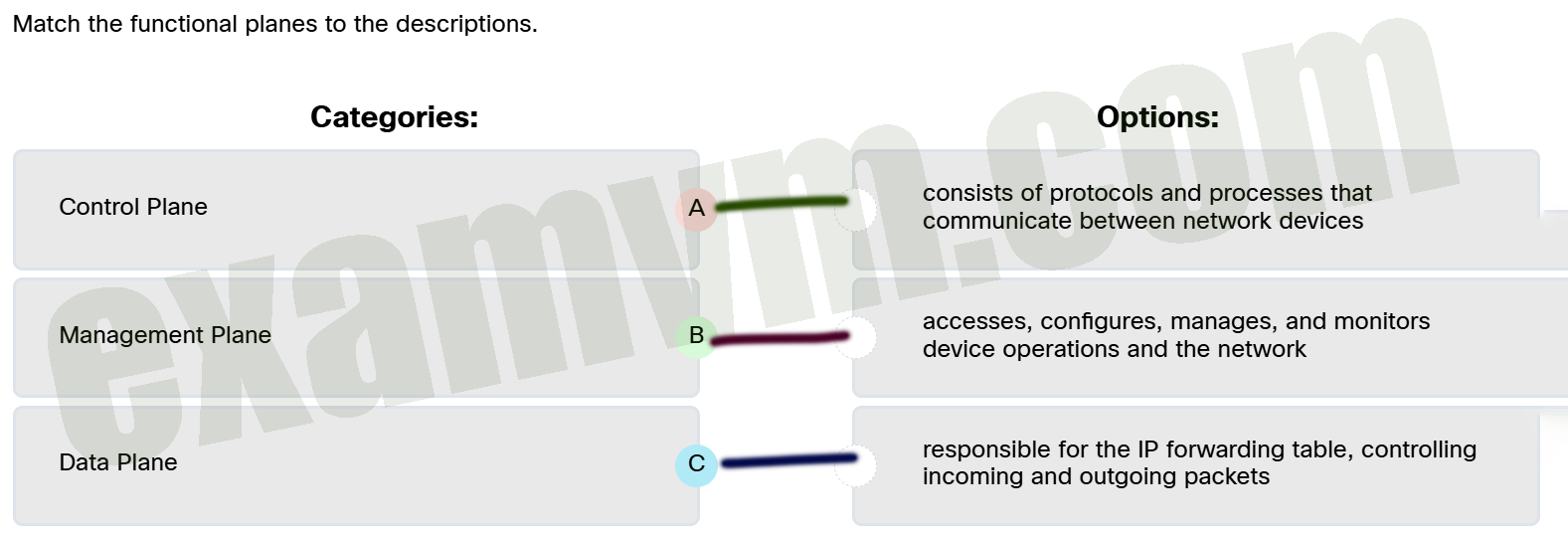
Match the functional planes to the descriptions - Control Plane ==> consists of protocols and processes that communicate between network devices
- Management Plane ==> accesses, configures, manages, and monitors device operations and the network
- Data Plane ==> responsible for the IP forwarding table, controlling incoming and outgoing packets
-
What method is used to secure programmable automation controllers (PAC) used in industrial IoT networks?
- Restricting physical access to authorized personnel, to ensure only those with permissions can interact with the PAC.
- Utilizing PACs, with factory default settings, for security and functionality without additional configuration.
- Utilizing consumer-grade network devices that lack advanced security features to connect PACs to the internet.
- Installing the Accounting feature of AAA to continuously monitor PAC assets and real-time auditing of user actions.
-
Which statement describes a key issue that contributes to the vulnerability of legacy systems in sectors such as energy, manufacturing, smart cities, and transportation?
- Legacy systems face minimal risk in connected networks as they were built for maximum resilience to cyber threats.
- Legacy systems were designed with modern security controls in mind and are easily patched to meet current standards.
- Legacy systems often cannot be readily patched or upgraded to support modern security controls, making them vulnerable.
- Legacy systems are primarily at risk from outdated hardware, but software upgrades usually resolve most security concerns.
-
Match the network hardening method to the description.
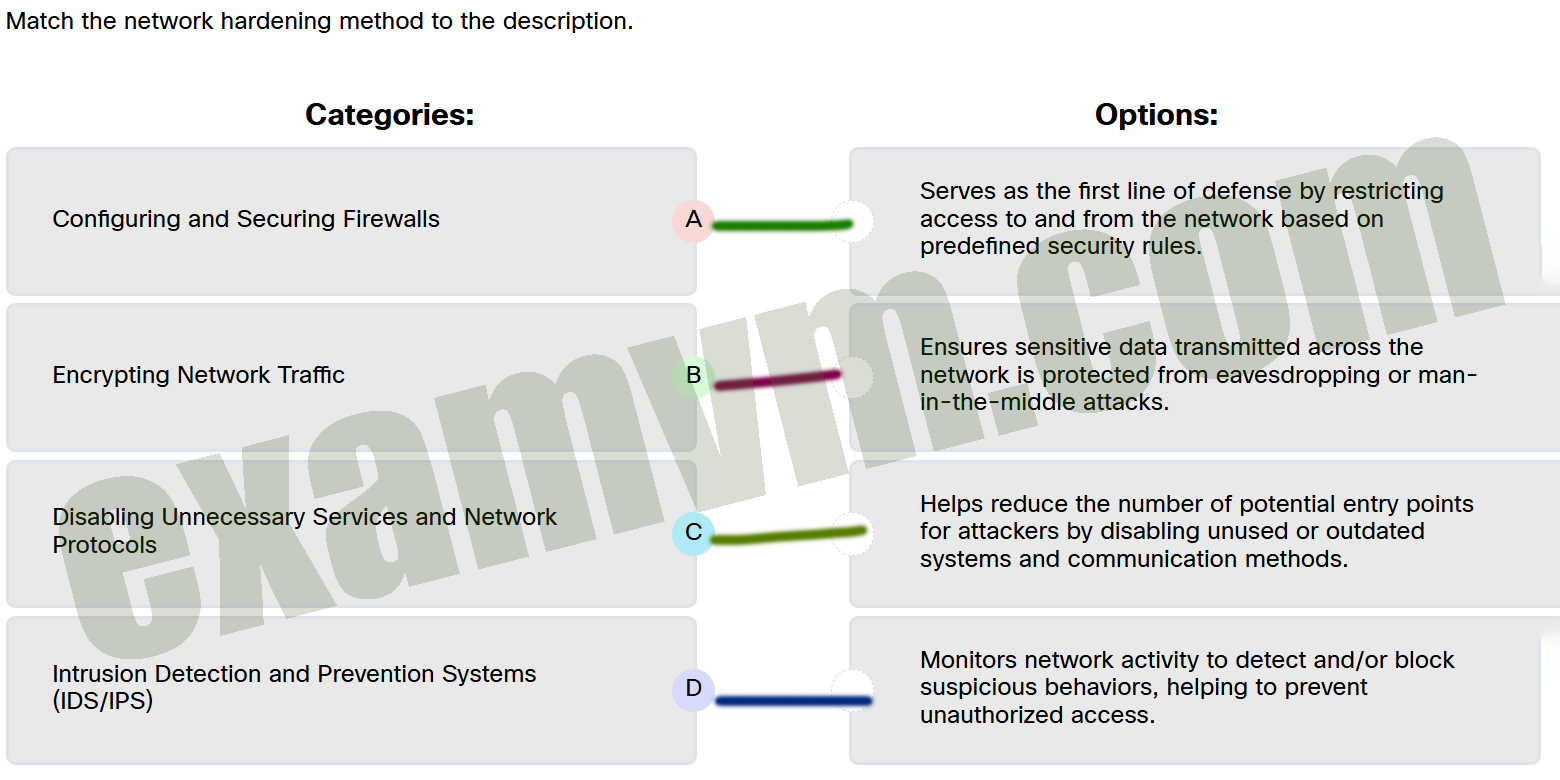
Match the network hardening method to the description - Configuring and Securing Firewalls ==> Serves as the first line of defense by restricting access to and from the network based on predefined security rules.
- Encrypting Network Traffic ==> Ensures sensitive data transmitted across the network is protected from eavesdropping or man-in-the-middle attacks.
- Disabling Unnecessary Services and Network Protocols ==> Helps reduce the number of potential entry points for attackers by disabling unused or outdated systems and communication methods.
- Intrusion Detection and Prevention Systems (IDS/IPS) ==> Monitors network activity to detect and/or block suspicious behaviors, helping to prevent unauthorized access.
-
Which statement describes the primary benefit of turning off unused services and disconnecting inactive devices in industrial environments?
- It increases the overall speed of the network by freeing up bandwidth.
- It simplifies network management by reducing the number of devices to monitor.
- It reduces the attack surface and helps prevent security vulnerabilities by eliminating idle systems.
- It allows for more efficient use of all internal network resources and enhances overall device performance.
-
Which statement describes a common vulnerability, that attackers can exploit, in many legacy industrial protocols like Modbus and DNP3?
- Legacy protocols like Modbus and DNP3 transmit encrypted data, ensuring that sensitive information remains secure.
- Replay attacks are not a concern for legacy protocols because they use secure timestamping or sequence numbers.
- Many legacy industrial protocols lack authentication mechanisms, allowing unauthorized devices to send harmful commands.
- Industrial protocols implement basic integrity checks, but these checks are insufficient to fully prevent data tampering by attackers.
-
Match the hardening technique to the description.
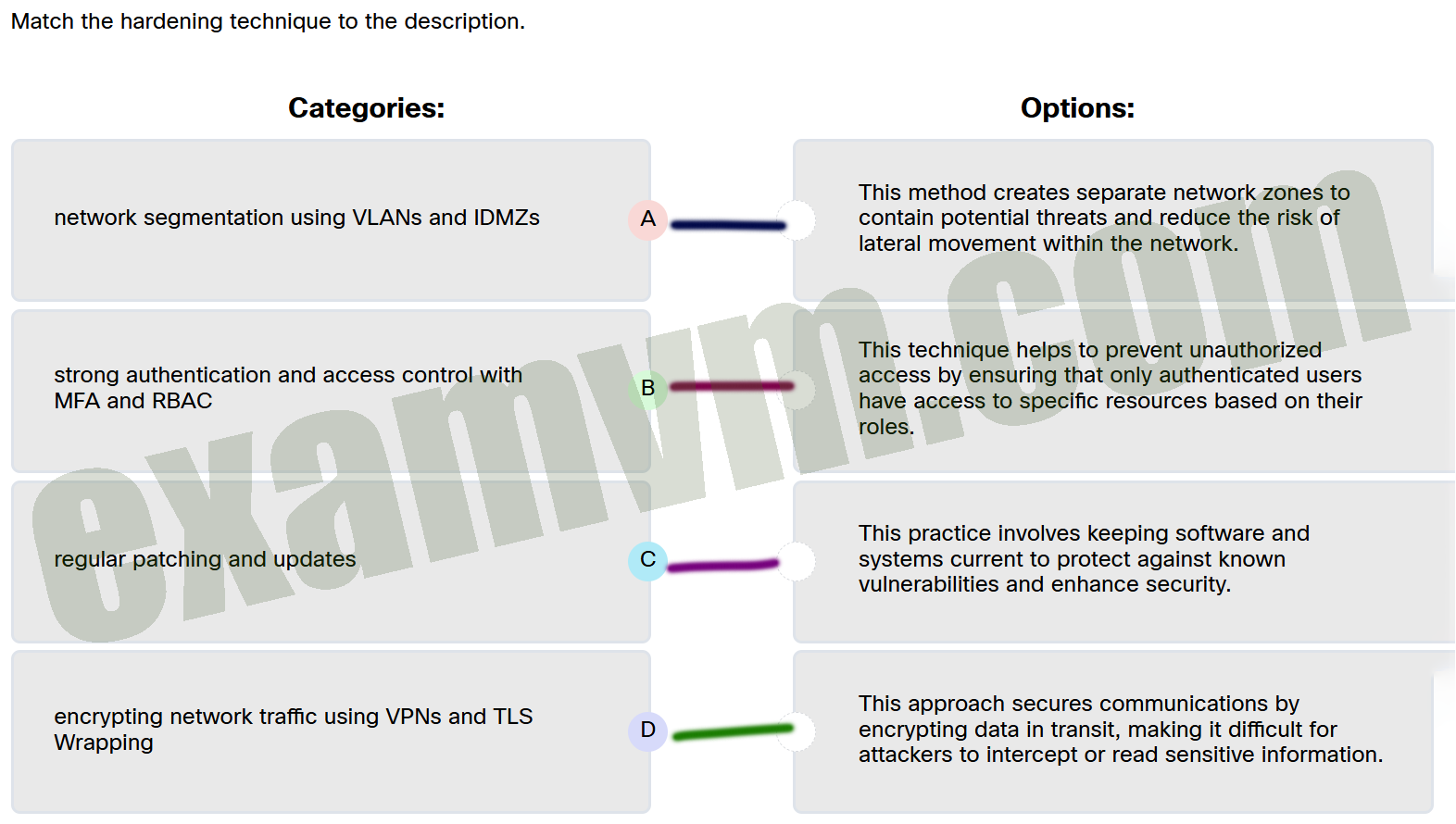
Match the hardening technique to the description - network segmentation using VLANs and IDMZs ==> This method creates separate network zones to contain potential threats and reduce the risk of lateral movement within the network.
- strong authentication and access control with MFA and RBAC ==> This technique helps to prevent unauthorized access by ensuring that only authenticated users have access to specific resources based on their roles.
- regular patching and updates ==> This practice involves keeping software and systems current to protect against known vulnerabilities and enhance security.
- encrypting network traffic using VPNs and TLS Wrapping ==> This approach secures communications by encrypting data in transit, making it difficult for attackers to intercept or read sensitive information.
-
Which statement describes the main benefit of implementing CIP Security in an industrial automation network?
- It increases the bandwidth available for device communications.
- It simplifies network management by reducing the number of protocols in use.
- It prevents attackers from spoofing devices or tampering with Ethernet/IP communications through authentication, encryption, and integrity checks.
- It allows devices to communicate over longer distances without signal degradation and simplifies network management by reducing the number of protocols in use.
-
Why is it important that events in the management and data planes do not impact the control plane in an industrial network?
- To avoid increasing bandwidth usage in the data plane.
- To maintain network stability and prevent events like DoS attacks.
- To ensure that network configurations remain intact during updates.
- To prevent unauthorized access to management plane resources.
-
Why are SCADA systems essential in industrial environments?
- They automate administrative tasks and reduce labor costs.
- They ensure data is encrypted during all network communications and automate administrative tasks, reducing labor costs.
- They enable real-time monitoring of plant operations and help control processes for peak efficiency and productivity.
- They protect the network from all cybersecurity threats.
-
Why is keeping firmware updated critical in industrial networks?
- Regular firmware updates prevent software licensing issues.
- Outdated firmware can introduce security vulnerabilities, allowing attackers to gain unauthorized access or disrupt processes.
- Up-to-date firmware ensures compliance with safety standards.
- Outdated firmware can enhance compatibility with certain legacy systems creating a lower risk of security vulnerabilities and operational inefficiencies.
-
What best practice is recommended for ensuring secure and effective firmware updates in industrial organizations?
- Delay firmware updates if systems are running smoothly to avoid unnecessary changes.
- Only download firmware updates when devices show signs of malfunction.
- Continuously monitor for updates, test them in a controlled environment, and use secure update methods.
- Apply all firmware updates immediately as they are released, regardless of testing, to ensure optimum security.