4.3.2 Quiz Module 4: Vulnerabilities Answers
4.3.2 Quiz Module 4: Vulnerabilities Answers
The 4.3.2 Quiz Module 4: Vulnerabilities Answers page helps students and cybersecurity learners review important concepts related to system vulnerabilities, threats, and security weaknesses commonly discussed in modern IT environments. This module focuses on identifying different types of vulnerabilities, understanding how attackers exploit them, and learning best practices for protecting networks, devices, and applications. By studying these quiz answers and explanations, learners can strengthen their cybersecurity knowledge, prepare for exams, and improve their understanding of real-world security risks and defense strategies.
1. What causes vulnerabilities to be frequently introduced into IIoT networks?
- lack of qualified personnel to manage the network
- use of outdated software and hardware technologies
- incomplete, inappropriate, or nonexistent security documentation
- physical attacks on the hardware components and external devices
The primary cause of vulnerabilities in network security, particularly in IIoT systems, is the need for adequate security documentation rather than the competence of personnel or outdated technologies. This documentation void needs to guide the secure lifecycle of IIoT systems, overshadowing the fewer significant risks posed by physical attacks or the use of obsolete technology.
2. What three functions are performed by endpoints in an IIoT environment? (Choose three.)
- directly managing production line changes
- initiating preventive maintenance protocols
- executing complex data analysis independently
- monitoring environmental conditions in real-time
- serving as the primary interface for user interaction
- sending operational data to central analytics platforms
In the Industrial Internet of Things (IIoT), endpoints play essential roles, such as sending operational data for analysis, real-time environmental monitoring, and initiating preventive maintenance to improve efficiency and safety and reduce costs. However, they usually do not handle complex data analysis, direct production line changes, or user interaction.
3. Which three Industrial Automation and Control System (IACS) components are most vulnerable to cybersecurity threats? (Choose three.)
- HMIs
- PLCs
- Network routers
- SCADA systems
- Ethernet switches
- Enterprise firewalls
Recent studies have highlighted that the most vulnerable components within IACS environments are Human Machine Interfaces (HMIs), Programmable Logic Controllers (PLCs), and SCADA systems. These components are crucial in managing and directing industrial processes and present attractive targets for cyber threats.
4. Match the endpoint within IACS environments to the associated potential vulnerabilities.
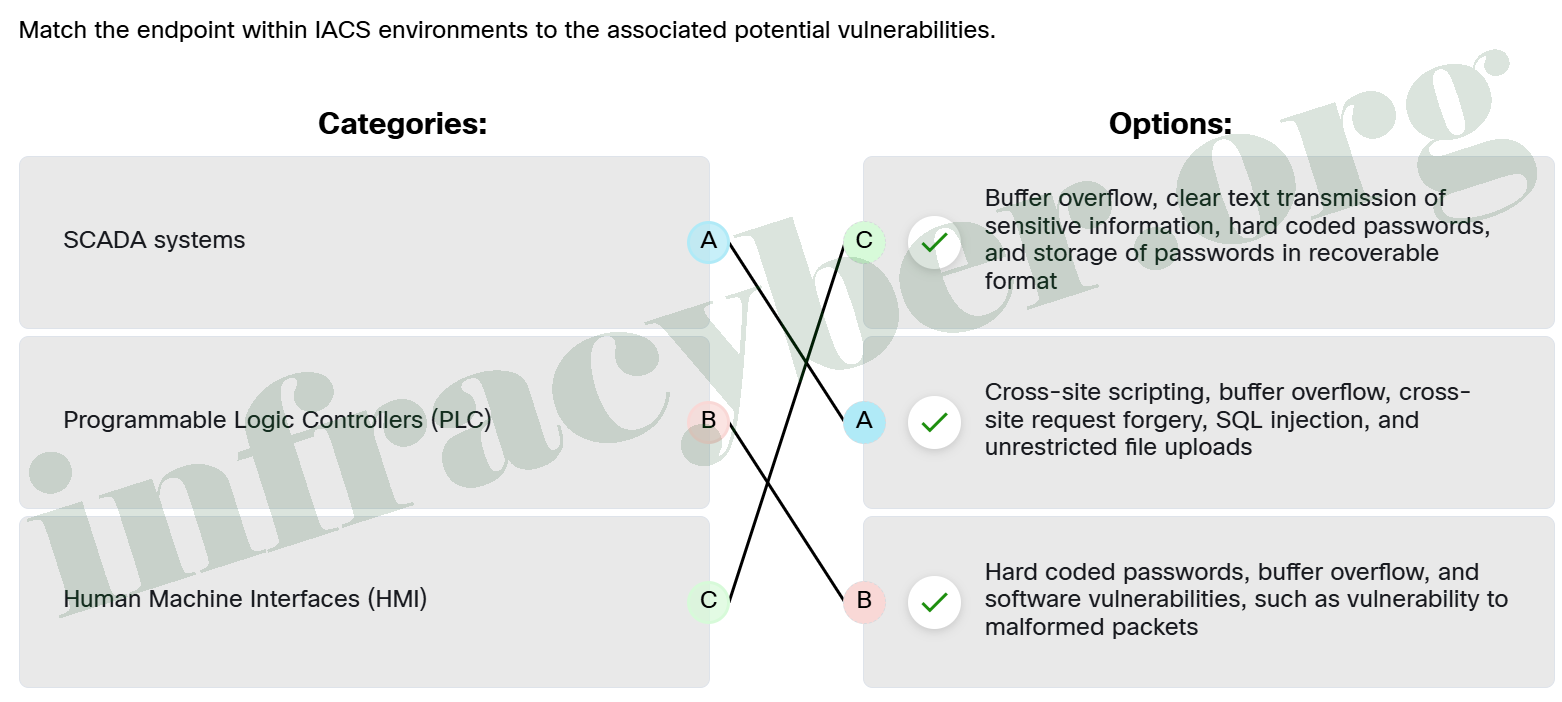
- Programmable Logic Controllers (PLC) ==> Hard coded passwords, buffer overflow, and software vulnerabilities, such as vulnerability to malformed packets
- Human Machine Interfaces (HMI) ==> Buffer overflow, clear text transmission of sensitive information, hard coded passwords, and storage of passwords in recoverable format
- SCADA systems ==> Cross-site scripting, buffer overflow, cross-site request forgery, SQL injection, and unrestricted file uploads
5. A web server processes requests from a client without verifying the underlying intention of those requests. Which SCADA vulnerability does this scenario describe?
- SQL Injection
- Denial of Service (DoS)
- Cross-Site Scripting (XSS)
- Cross-Site Request Forgery (CSRF)
Cross-Site Request Forgery (CSRF) is a type of security vulnerability that occurs when a hostile website, email, or program causes a user’s web browser to perform an undesirable action on a trusted site for which the user is currently authenticated.
6. Match IoT device software vulnerability to the description.
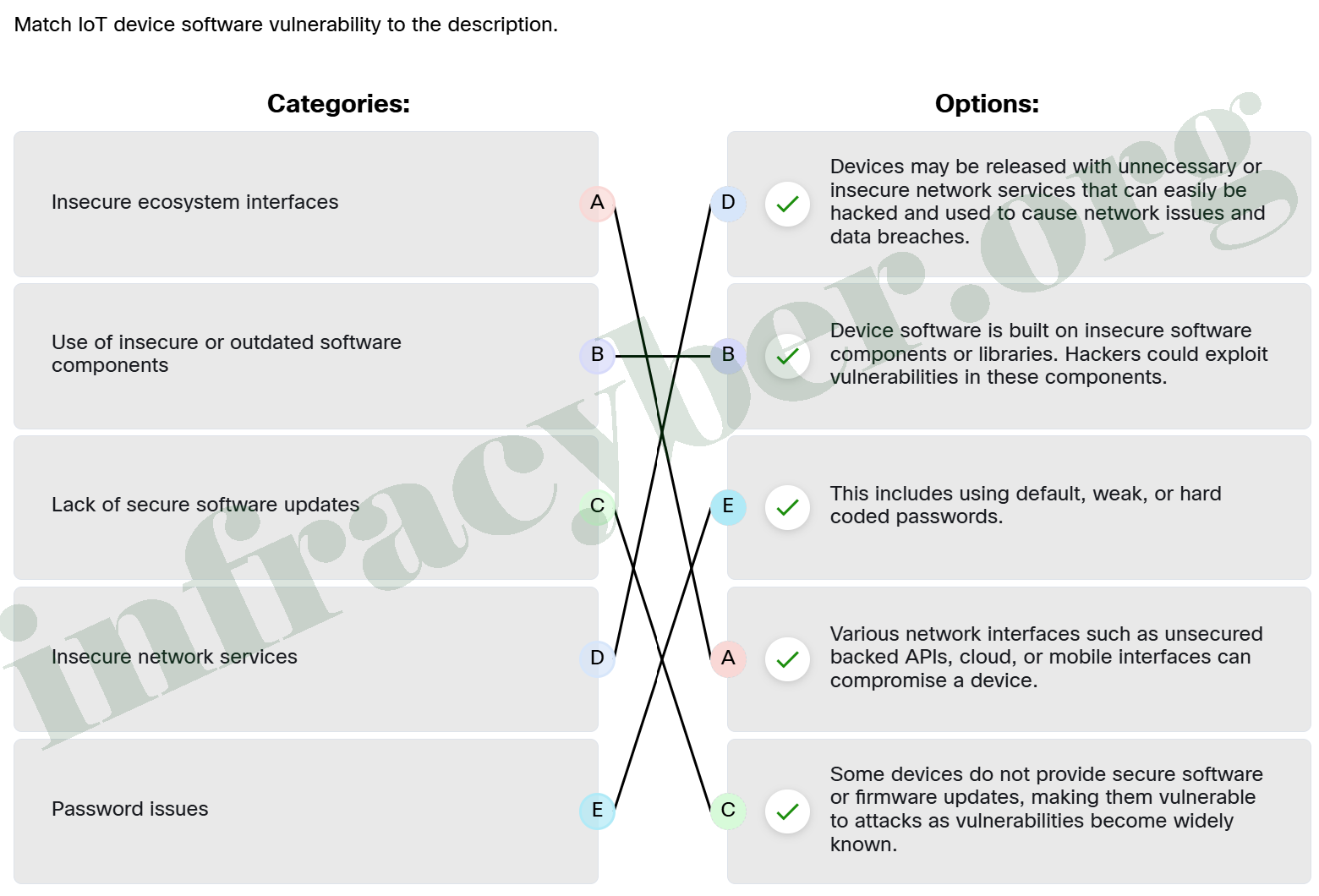
- Password issues ==> This includes using default, weak, or hard coded passwords.
- Lack of secure software updates ==> Some devices do not provide secure software or firmware updates, making them vulnerable to attacks as vulnerabilities become widely known.
- Insecure network services ==> Devices may be released with unnecessary or insecure network services that can easily be hacked and used to cause network issues and data breaches.
- Insecure ecosystem interfaces ==> Various network interfaces such as unsecured backed APIs, cloud, or mobile interfaces can compromise a device.
- Use of insecure or outdated software components ==> Device software is built on insecure software components or libraries. Hackers could exploit vulnerabilities in these components.
7. What statement is true regarding industrial protocols?
- Industrial protocols are designed with a focus on interoperability between different vendor systems.
- Developing industrial protocols prioritizes security over business continuity, safety, and availability.
- Industrial protocols often need more interoperability between systems of different vendors due to their initial proprietary development.
- Industrial protocols were primarily developed to enhance the aesthetic interface of industrial systems rather than focusing on specific functionality.
Industrial protocols were initially developed for proprietary systems, which explains their minimal or no interoperability between systems of different vendors. The main focus during their development was ensuring business continuity, safety, and availability of industrial processes. Consequently, the security issue in these protocols was addressed afterward, not because it was deemed unimportant but because the operational needs were prioritized to maintain the integrity of industrial operations.
8. What does the term “Modbus” stand for in industrial communication networks?
- a specific type of connector used exclusively in industrial Ethernet
- an encryption standard for securing communications in industrial settings
- a protocol named after Modicon (Modular Digital Controller) Communication Bus
- a proprietary software platform for programming PLCs (Programmable Logic Controllers)
Modbus stands for Modicon (Modular Digital Controller) Communication Bus. It is an OSI application layer messaging protocol that allows efficient communications between interconnected assets based on request-response methodology.
9. Match PROFINET standard performance class to the description.
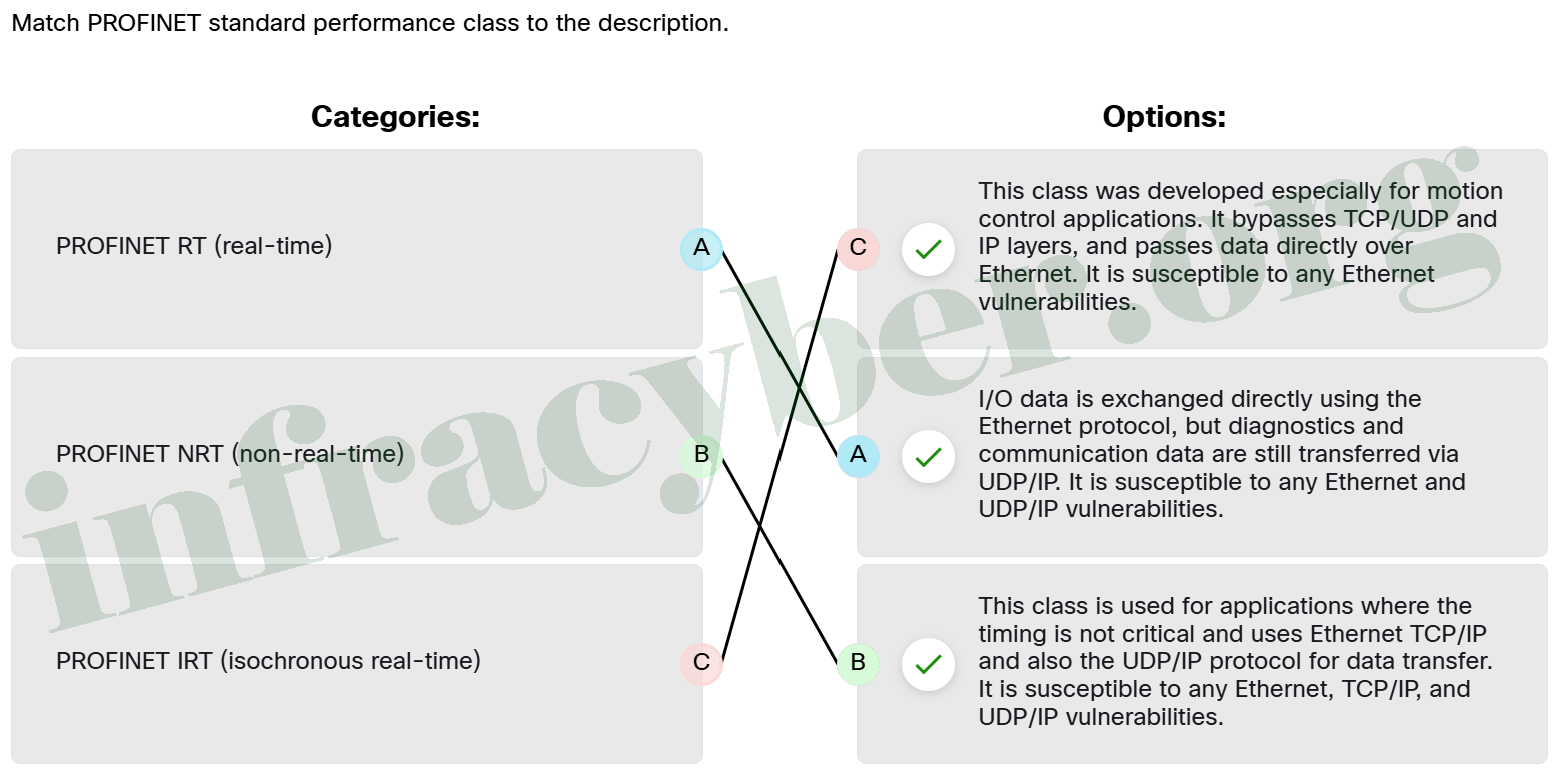
- PROFINET RT (real-time) ==> I/O data is exchanged directly using the Ethernet protocol, but diagnostics and communication data are still transferred via UDP/IP. It is susceptible to any Ethernet and UDP/IP vulnerabilities.
- PROFINET IRT (isochronous real-time) ==> This class was developed especially for motion control applications. It bypasses TCP/UDP and IP layers, and passes data directly over Ethernet. It is susceptible to any Ethernet vulnerabilities.
- PROFINET NRT (non-real-time) ==> This class is used for applications where the timing is not critical and uses Ethernet TCP/IP and also the UDP/IP protocol for data transfer. It is susceptible to any Ethernet, TCP/IP, and UDP/IP vulnerabilities.
10. What five systems commonly undergo vulnerability assessments? (Choose five.)
- Water supply systems
- Energy supply systems
- Transportation systems
- Fast food ordering kiosks
- Personal gaming systems
- Residential security systems
- Communication systems
- Industrial automation and control systems
- Home computer systems
Vulnerability assessments are a crucial process for identifying, quantifying, and prioritizing vulnerabilities in a variety of systems. Specifically, these are essential for IT systems, industrial automation and control systems, energy supply systems, water supply systems, transportation systems, and communication systems.
11. What are three types of vulnerability assessments? (Choose three.)
- Blue box
- Gray box
- Black box
- Green box
- Brown box
- White box
Vulnerability assessment can be classified into three different types:
White box – These assessors have knowledge of the network systems that they are assessing. They can focus on specific aspects of the system to execute their assessments. These testers frequently operate from within the organization.
Black box – This assessment is the closest to an actual attack. The assessors, who are usually working for a third party, have no knowledge of the network architecture prior to conducting their assessment.
Gray box – White box testers identify the vulnerabilities, and then black box testers are hired to target the discovered vulnerabilities. A gray box tester has partial knowledge of the network systems they are testing including access to the documentation of internal network architecture. The goal is to verify the vulnerabilities, determine the ease of exploiting them, and to determine the potential impacts of exploits.
12. What is the primary purpose of using port mapping tools in network security?
- to randomly close open ports on network devices without analysis
- to encrypt data packets sent through open ports to ensure security
- to discover open TCP/UDP ports on end systems and network devices
- to increase the number of open ports on network devices for better accessibility
Port mapping tools are essential in cybersecurity for identifying open TCP/UDP ports on end systems and network devices. These open ports, while necessary for certain services and applications, also offer potential access points for unauthorized users or hackers.
13. What is the primary aim of the FIDO (Fast IDentity Online) Alliance within the context of the IIoT?
- To enforce uniform security protocols across all IoT devices.
- To increase the reliance on traditional password-based authentication.
- To promote the development and adoption of authentication standards that reduce the reliance on passwords.
- To centralize the management of IoT devices through a singular global platform and increase the reliance on security protocols.
The FIDO (Fast IDentity Online) Alliance is an open industry association that is focused on reducing the global reliance on passwords. The FIDO Alliance promotes the development, use, and compliance with standards for authentication and device identity.
14. What three tools are commonly used to break passwords? (Choose three.)
- Wfuzz
- Yfizz
- Brutus
- Dashdog
- John the Ripper
- Jason the Slayer
Hashcat, Wfuzz, John the Ripper, Brutus, and Hydra are tools commonly used to break passwords.
15. Which statement describes the Common Vulnerability Support System (CVSS)?
- It is a standard framework for operating and managing video surveillance systems.
- It is an open framework for conveying the severity of vulnerabilities in software and hardware.
- It offers Solutions aimed at enhancing cybersecurity through collaboration and shared resources.
- It is a system dedicated to providing full support for vulnerabilities after they have been identified.
The Common Vulnerability Scoring System (CVSS) is an industry-standard and vendor-neutral guideline that offers an open framework for rating the severity of security vulnerabilities in software and hardware.