6.4.2 Quiz Module 6: Securing Industrial Networks Answers
6.4.2 Quiz Module 6: Securing Industrial Networks Answers
The 6.4.2 Quiz Module 6: Securing Industrial Networks Answers provide the correct answers to questions focused on protecting industrial networks and operational technology environments from cybersecurity threats. These answers help learners review key concepts such as network segmentation, access control, firewalls, secure protocols, monitoring, defense-in-depth, industrial control system security, and methods for reducing risks in IACS environments. By studying the Module 6 Securing Industrial Networks Answers, learners can strengthen their understanding of industrial cybersecurity and prepare more confidently for the quiz and related assessments.
-
Which approach is the best one to mitigate security risks in manufacturing environments?
- Create a single security layer focused on external threats.
- Utilize a defense-in-depth security approach using multiple layers of defense.
- Focus solely on physical security to prevent unauthorized access.
- Rely exclusively on strict electronic security systems to manage internal threats.
-
When implementing security in an industrial IoT network, what should be the first step in creating the basic security policy?
- Secure communications between zones (conduits).
- Provide strict physical security and secure communications.
- Create access controls for network segments (zones).
- Enable network security monitoring.
-
Match each network security term to the description.
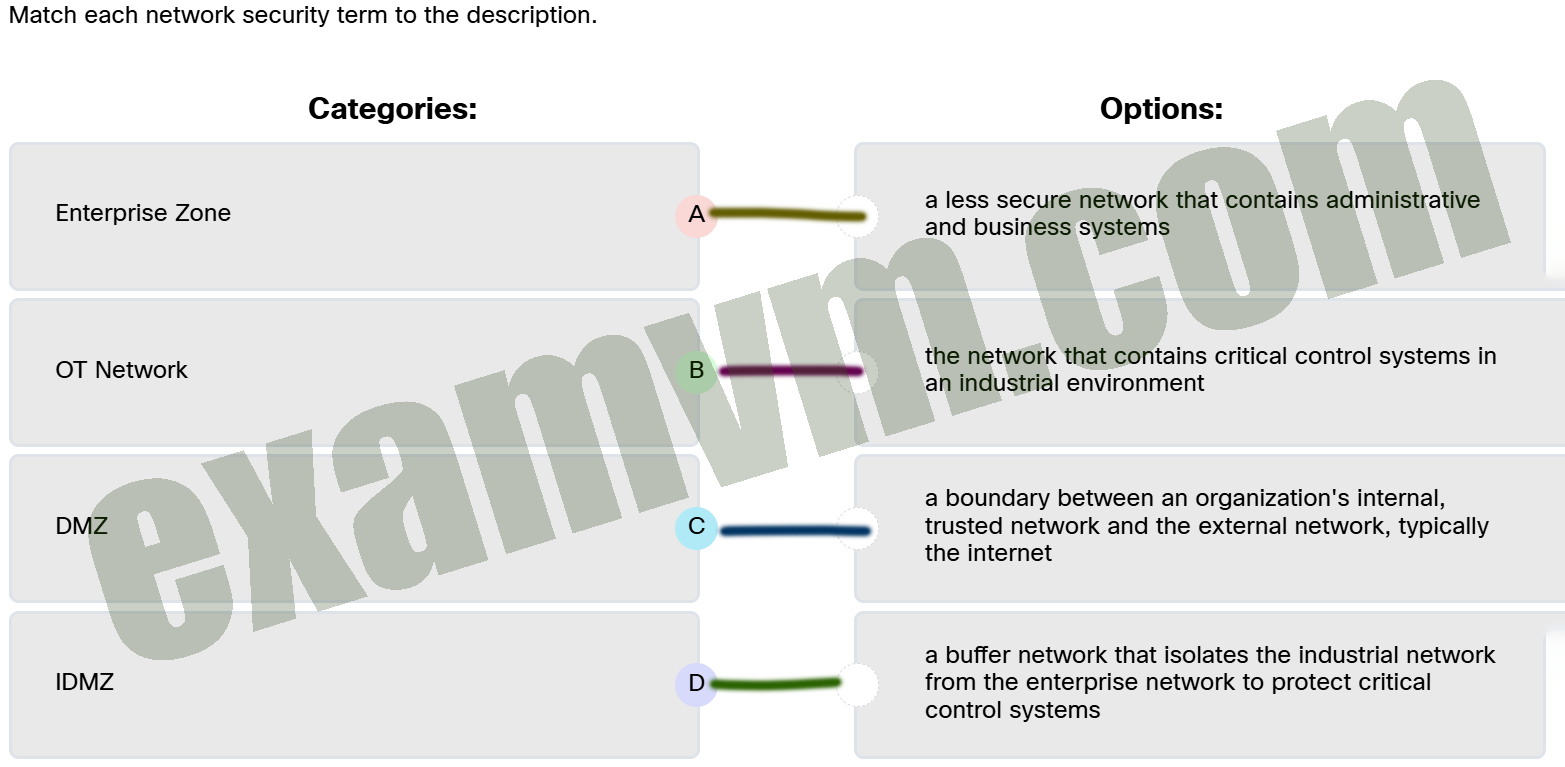
Match each network security term to the description - Enterprise Zone ==> a less secure network that contains administrative and business systems
- OT Network ==> the network that contains critical control systems in an industrial environment
- DMZ ==> a boundary between an organization’s internal, trusted network and the external network, typically the internet
- IDMZ ==> a buffer network that isolates the industrial network from the enterprise network to protect critical control systems
-
In a converged manufacturing and enterprise network, what key service is provided by a firewall to ensure secure data sharing between the industrial and enterprise zones?
- It automatically grants unrestricted access to the OT network for enterprise users.
- It ignores traffic flow between the industrial and enterprise zones.
- It enforces authentication of users trying to access data or services.
- It bypasses stateful packet inspection to speed up communications.
-
In the context of data sharing between the industrial and enterprise zones, match each component to the description.
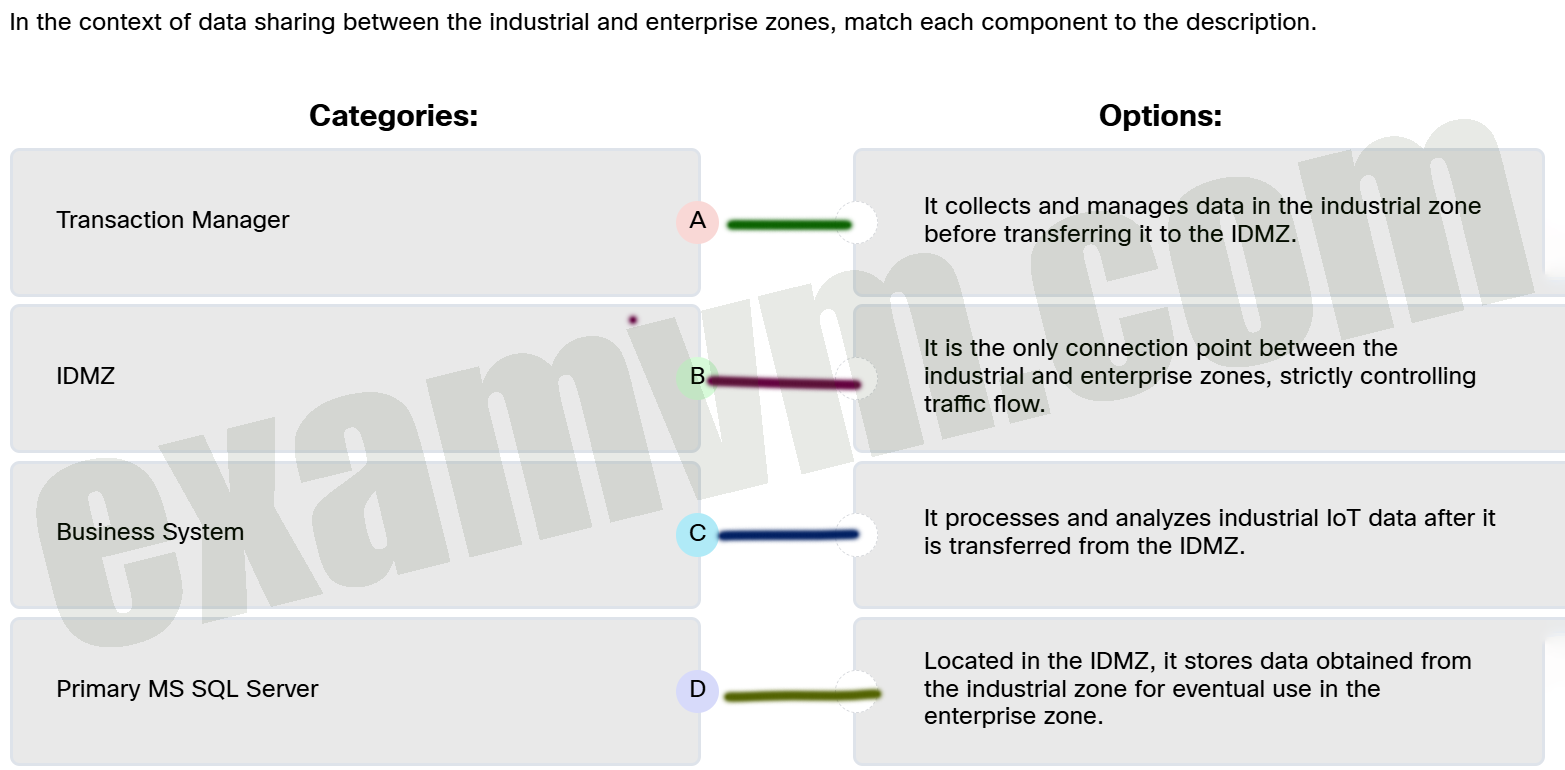
In the context of data sharing between the industrial and enterprise zones, match each component to the description - Transaction Manager ==> It collects and manages data in the industrial zone before transferring it to the IDMZ.
- IDMZ ==> It is the only connection point between the industrial and enterprise zones, strictly controlling traffic flow.
- Business System ==> It processes and analyzes industrial IoT data after it is transferred from the IDMZ.
- Primary MS SQL Server ==> Located in the IDMZ, it stores data obtained from the industrial zone for eventual use in the enterprise zone.
-
What consideration is most important for determining the optimal traffic flow of IIoT application data?
- How quickly can a new application be developed for the enterprise zone?
- What are the bandwidth limitations between zones and must this service be configured explicitly for the industrial zone?
- How many users are accessing the application from the industrial zone?
- Where are the clients and servers placed to support integration between the enterprise and industrial zones?
-
Match each availability consideration or recommendation, related to the IDMZ-to-industrial zone connection and the placement of applications and services, to the description.
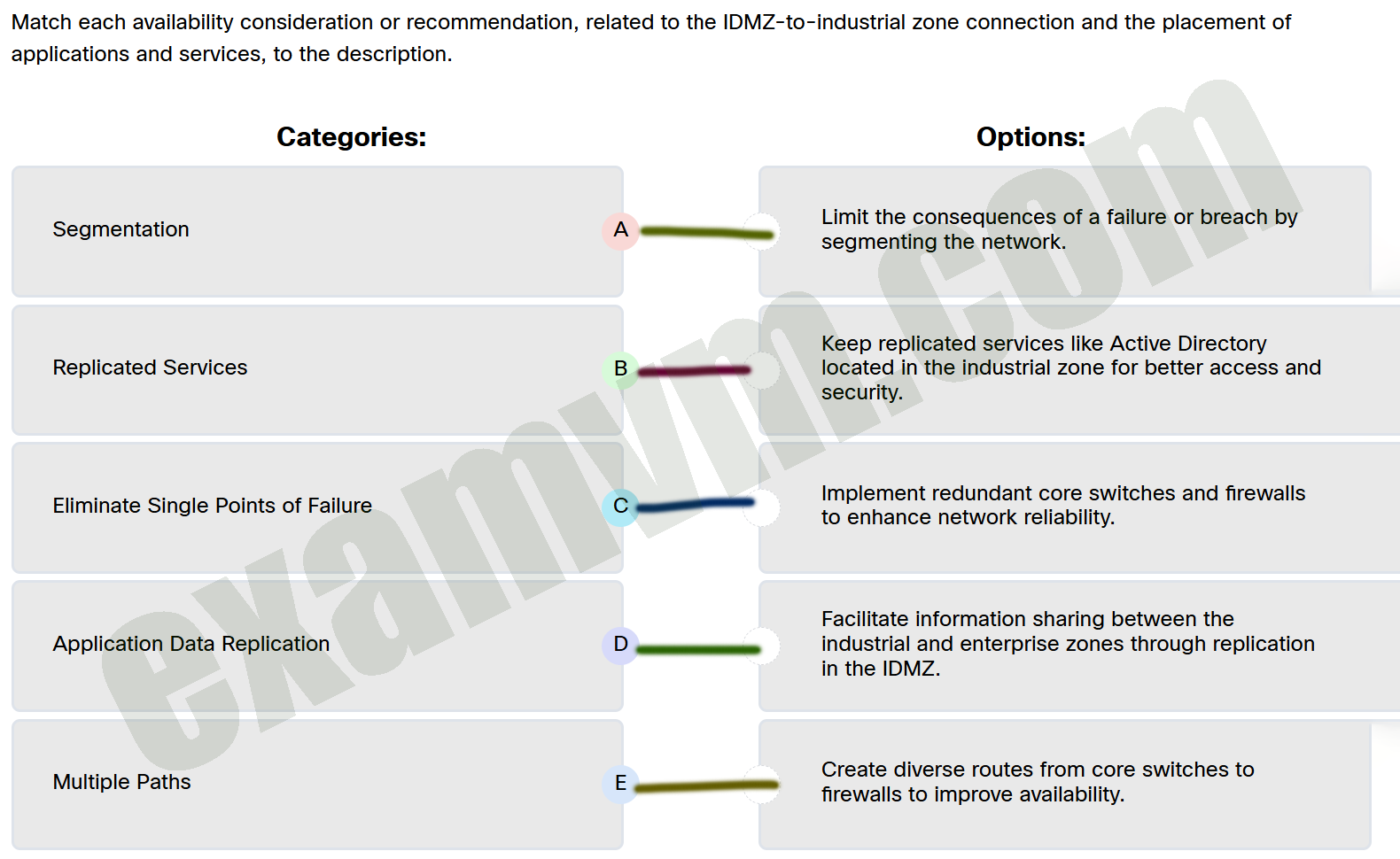
Match each availability consideration or recommendation, related to the IDMZ-to-industrial zone connection and the placement of applications and services, to the description - Segmentation ==> Limit the consequences of a failure or breach by segmenting the network.
- Replicated Services ==> Keep replicated services like Active Directory located in the industrial zone for better access and security.
- Eliminate Single Points of Failure ==> Implement redundant core switches and firewalls to enhance network reliability.
- Application Data Replication ==> Facilitate information sharing between the industrial and enterprise zones through replication in the IDMZ.
- Multiple Paths ==> Create diverse routes from core switches to firewalls to improve availability.
-
What is one of the primary functions of the Cisco Secure Firewall ISA 3000 in Industrial Automation and Control Systems (IACS) networks?
- It focuses on enhancing physical security measures.
- It eliminates the need for network segmentation.
- It supports network segmentation to create distinct trust zones with specific security policies.
- It functions as a traditional firewall without advanced features.
-
In (IACS) networks, which term is used to describe the horizontal communication among peer-to-peer IACS devices?
- Lateral communication
- Vertical communication
- East-West communication
- North-South communication
-
In an IACS (Industrial Automation and Control Systems) network, what methods can be used to effectively secure traffic flows?
- Both North-South and East-West traffic should be controlled.
- Controlling North-South traffic is not necessary, as most attacks originate from East-West lateral movements.
- Only East-West traffic must be controlled because attackers focus primarily on moving laterally once inside the network.
- Controlling North-South traffic is sufficient for network security because East-West traffic involves only internal communications and poses no risk.
-
Match the security principle to the description.
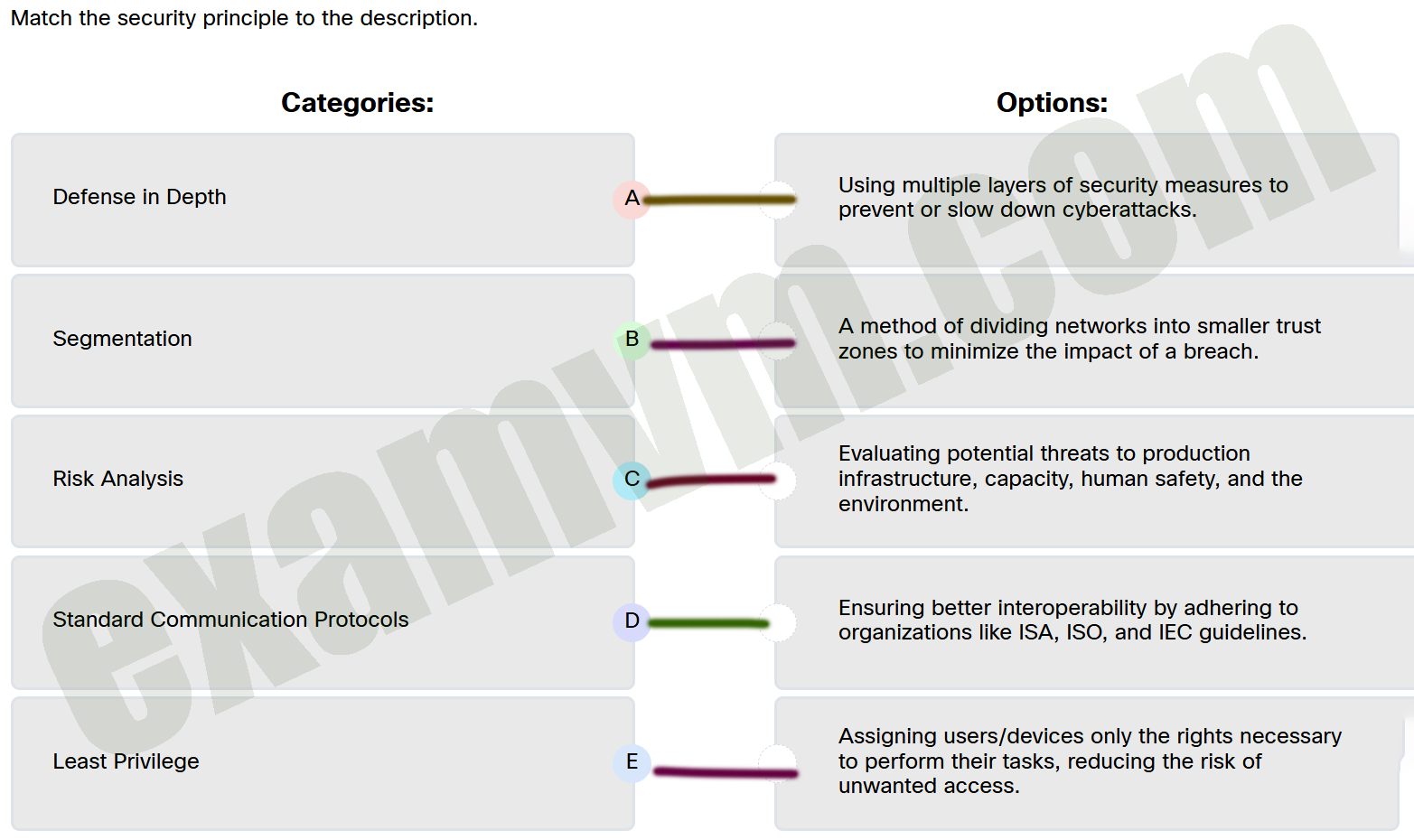
Match the security principle to the description - Defense in Depth ==> Using multiple layers of security measures to prevent or slow down cyberattacks.
- Segmentation ==> A method of dividing networks into smaller trust zones to minimize the impact of a breach.
- Risk Analysis ==> Evaluating potential threats to production infrastructure, capacity, human safety, and the environment.
- Standard Communication Protocols ==> Ensuring better interoperability by adhering to organizations like ISA, ISO, and IEC guidelines.
- Least Privilege ==> Assigning users/devices only the rights necessary to perform their tasks, reducing the risk of unwanted access.
-
Match the network segmentation technology to the description.
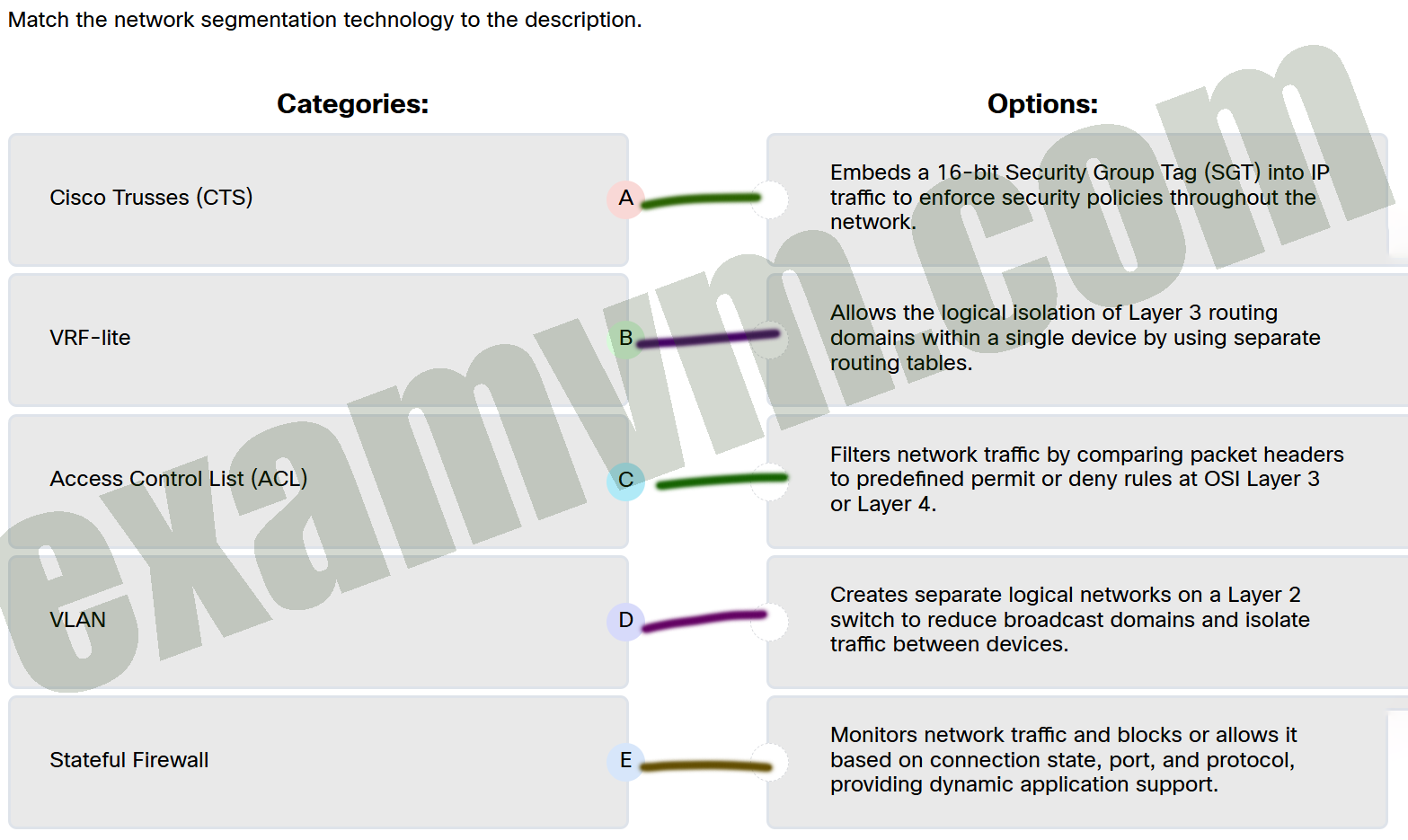
Match the network segmentation technology to the description - Cisco Trusses (CTS) ==> Embeds a 16-bit Security Group Tag (SGT) into IP traffic to enforce security policies throughout the network.
- VRF-lite ==> Allows the logical isolation of Layer 3 routing domains within a single device by using separate routing tables.
- Access Control List (ACL) ==> Filters network traffic by comparing packet headers to predefined permit or deny rules at OSI Layer 3 or Layer 4.
- VLAN ==> Creates separate logical networks on a Layer 2 switch to reduce broadcast domains and isolate traffic between devices.
- Stateful Firewall ==> Monitors network traffic and blocks or allows it based on connection state, port, and protocol, providing dynamic application support.
-
Which statement describes the concept of “zones and conduits” as introduced by IEC 62443?
- Zones are areas with no defined borders, while conduits represent physical movement of people between them.
- Conduits represent all devices within a zone, and zones are the channels that define communication between conduits.
- Zones represent a collection of all assets in an industrial network, and conduits define physical barriers between them.
- A zone is a group of assets with similar security requirements and a conduit defines allowed communication between zones.
-
How might a network traffic analyzer like Wireshark help engineers investigate a malfunctioning assembly line robot?
- It can modify the robot’s programming to correct the malfunction directly.
- It automatically blocks any traffic that seems suspicious or abnormal without human intervention.
- It encrypts the network traffic between the robot’s controller and PLC to prevent unauthorized access.
- It allows engineers to capture and analyze the data packets between the robot’s controller and the PLC to identify irregular or abnormal traffic.
-
What two tools rely on baselines to trigger alerts when anomalous network behavior occurs? (Choose two.)
- DMZ
- SIEM
- VRF-Lite
- IDS
- VLAN
- Cisco Trusses