7.4.2 Quiz Module 7: Authentication and Authorization Controls Answers
7.4.2 Quiz Module 7: Authentication and Authorization Controls Answers
The 7.4.2 Quiz Module 7: Authentication and Authorization Controls Answers provide the correct answers to questions focused on verifying user identities and controlling access to systems and resources. These answers help learners review key concepts such as authentication methods, authorization, access control models, passwords, multi-factor authentication, user roles, permissions, and the principle of least privilege. By studying the Module 7 Authentication and Authorization Controls Answers, learners can strengthen their understanding of identity and access management and prepare more confidently for the quiz and related assessments.
-
In an AAA-enabled network, a user issues the configure terminal command from the privileged executive mode of operation. What AAA function is at work if this command is rejected?
- authentication
- authorization
- accounting
- auditing
-
Why is maintaining a complete and accurate device inventory important in industrial settings?
- It helps to identify unknown or unauthorized devices on the network.
- It reduces the need for regular security audits.
- It eliminates the need for vulnerability assessments.
- It increases the number of devices that can connect to the network remotely.
-
Which three are examples of physical access control mechanisms commonly used to secure critical industrial facilities? (Choose three.)
- keycards
- firewalls
- biometric readers
- security personnel
- encryption protocols
- intrusion detection software
- virtual private networks
-
What control method is an example of logical access control commonly used to protect digital systems and data in industrial environments?
- surveillance cameras
- role-based access control (RBAC)
- multiple biometric scanners for room entry
- firewalls
-
Match the types of NAC (Network Access Control) to the description.
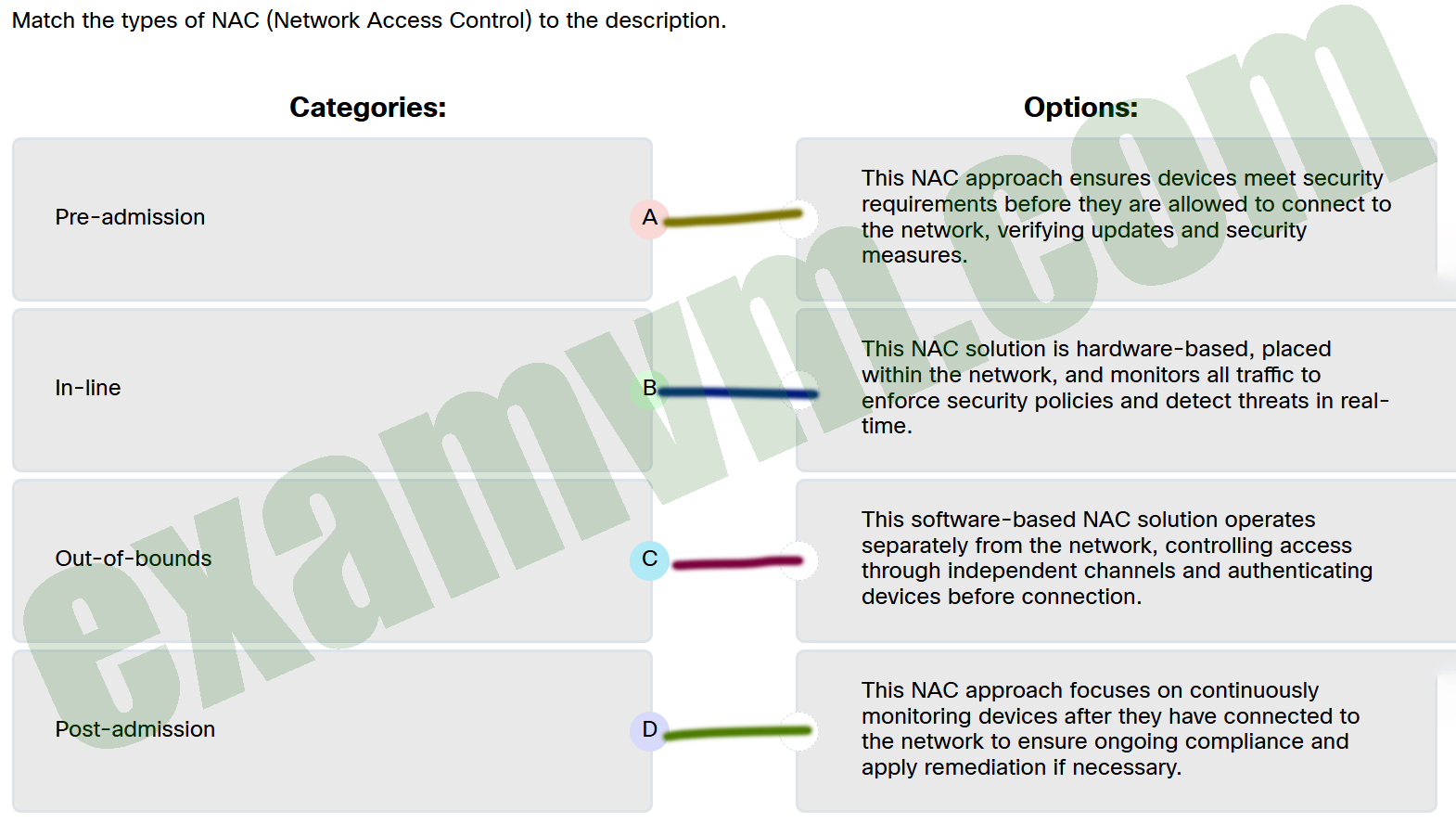
Match the types of NAC (Network Access Control) to the description - Pre-admission ==> This NAC approach ensures devices meet security requirements before they are allowed to connect to the network, verifying updates and security measures.
- In-line ==> This NAC solution is hardware-based, placed within the network, and monitors all traffic to enforce security policies and detect threats in real-time.
- Out-of-bounds ==> This software-based NAC solution operates separately from the network, controlling access through independent channels and authenticating devices before connection.
- Post-admission ==> This NAC approach focuses on continuously monitoring devices after they have connected to the network to ensure ongoing compliance and apply remediation if necessary.
-
When selecting a Network Access Control (NAC) solution, why is network topology an important factor to consider?
- It helps to determine if the NAC solution can block specific IP addresses.
- It ensures that the NAC solution can integrate with the organization’s firewall.
- It influences whether a cloud-based or on-premises NAC solution is more appropriate.
- It helps to decide how many devices can successfully connect to the network simultaneously.
-
What is the purpose of understanding the four primary models of access control?
- to eliminate the need for any form of user authentication
- to simplify the process of managing physical security measures
- to ensure that all users have the same level of access to all resources
- to choose the most appropriate system to meet specific security needs and operational requirements
-
Match the access control model to the descriptions.
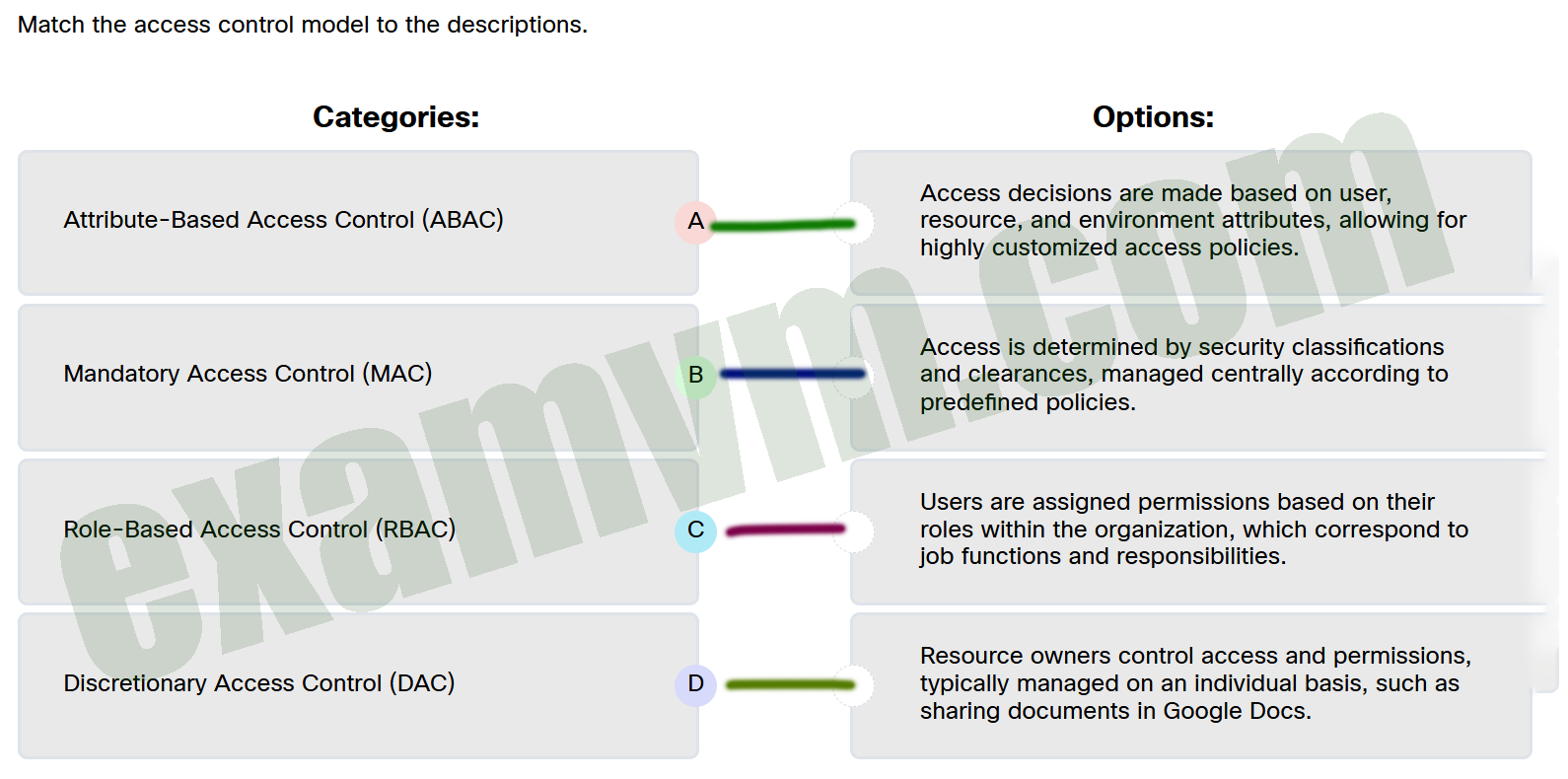
Match the access control model to the descriptions - Attribute-Based Access Control (ABAC) ==> Access decisions are made based on user, resource, and environment attributes, allowing for highly customized access policies.
- Mandatory Access Control (MAC) ==> Access is determined by security classifications and clearances, managed centrally according to predefined policies.
- Role-Based Access Control (RBAC) ==> Users are assigned permissions based on their roles within the organization, which correspond to job functions and responsibilities.
- Discretionary Access Control (DAC) ==> Resource owners control access and permissions, typically managed on an individual basis, such as sharing documents in Google Docs.
-
What is a key consideration when implementing Network Access Control (NAC) in an organization?
- avoiding any changes or disruptions to the current network setup and infrastructure
- allowing unrestricted access to all devices for easier integration
- careful planning and execution to ensure proper configuration and integration with existing network infrastructure
- focusing on user authentication forensics, device security, and allowing remote access to all users during initial setup
-
What is a critical security measure for accessing the management plane of IACS networks?
- using secured protocols for remote access and allow unrestricted access on-site
- limiting management plane access to physical on-site personnel only
- implementing multi-factor authentication and strict role-based access control
- allowing any user unrestricted access to secure channels within the organization
-
Match the security measure to its description.
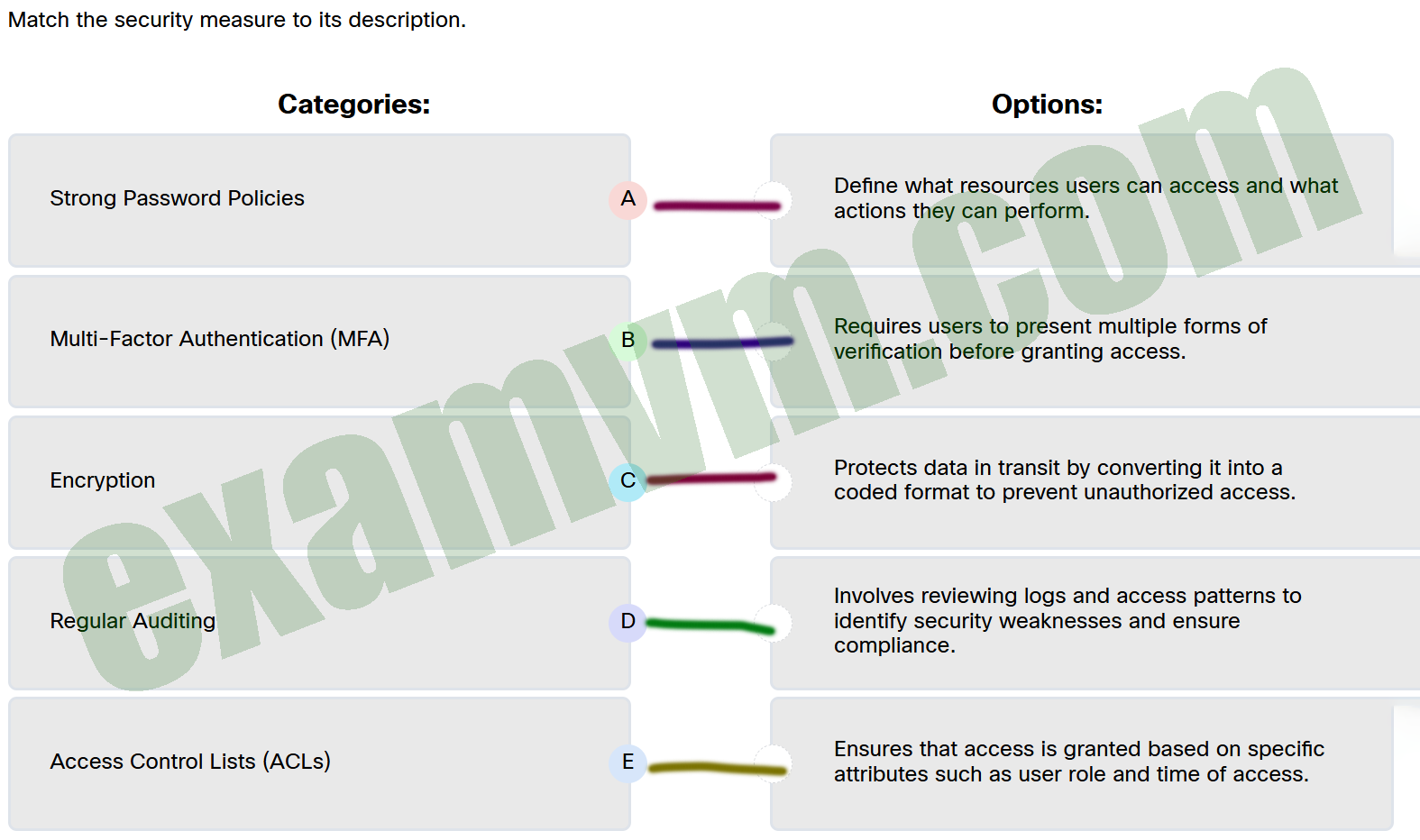
Match the security measure to its description - Strong Password Policies ==> Define what resources users can access and what actions they can perform.
- Multi-Factor Authentication (MFA) ==> Requires users to present multiple forms of verification before granting access.
- Encryption ==> Protects data in transit by converting it into a coded format to prevent unauthorized access.
- Regular Auditing ==> Involves reviewing logs and access patterns to identify security weaknesses and ensure compliance.
- Access Control Lists (ACLs) ==> Ensures that access is granted based on specific attributes such as user role and time of access.
-
Match VPN technology to the description.
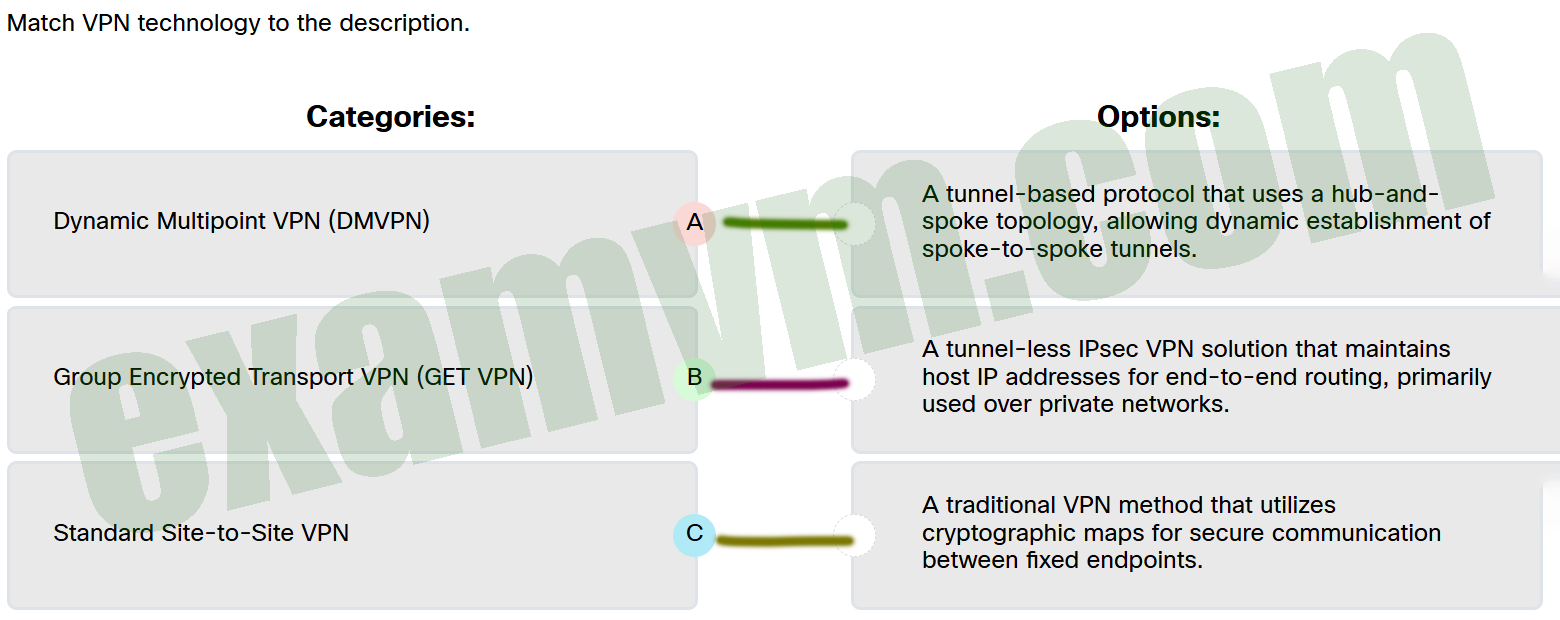
Match VPN technology to the description - Dynamic Multipoint VPN (DMVPN) ==> A tunnel-based protocol that uses a hub-and-spoke topology, allowing dynamic establishment of spoke-to-spoke tunnels.
- Group Encrypted Transport VPN (GET VPN) ==> A tunnel-less IPsec VPN solution that maintains host IP addresses for end-to-end routing, primarily used over private networks.
- Standard Site-to-Site VPN ==> A traditional VPN method that utilizes cryptographic maps for secure communication between fixed endpoints.
-
Match authentication factor to the description.
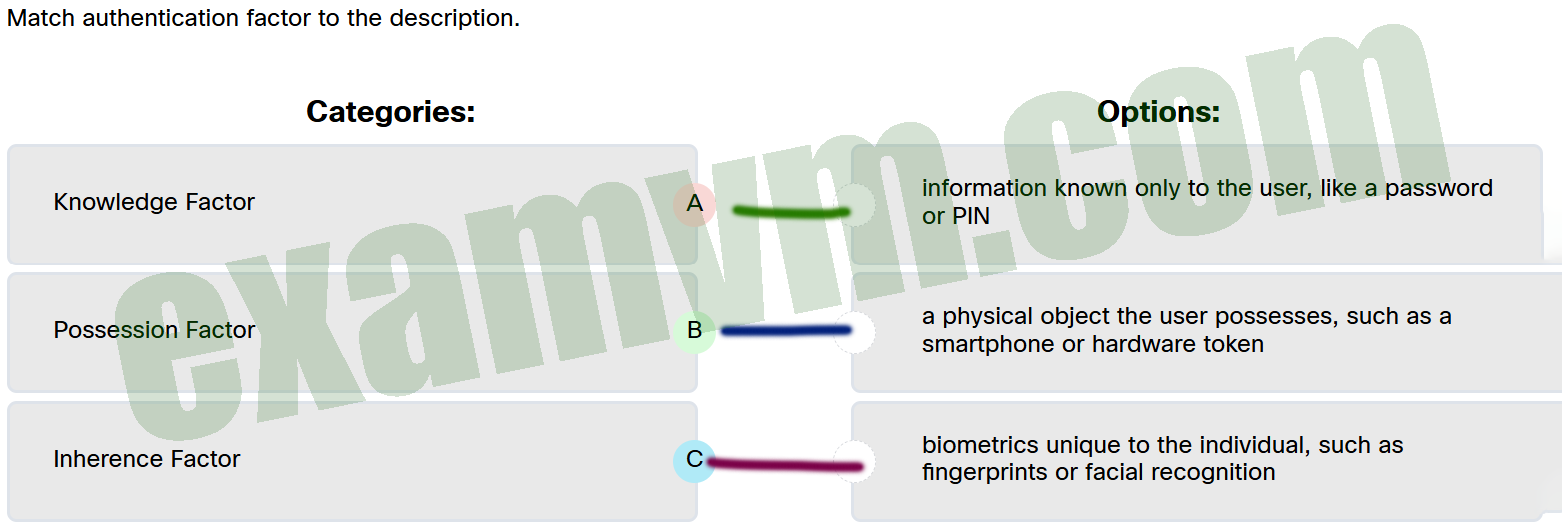
Match authentication factor to the description - Knowledge Factor ==> information known only to the user, like a password or PIN
- Possession Factor ==> a physical object the user possesses, such as a smartphone or hardware token
- Inherence Factor ==> biometrics unique to the individual, such as fingerprints or facial recognition
-
Which characteristic describes a rogue wireless access point (AP) in a network?
- a legitimate access point that is approved and configured according to network security policies
- a personal device connected to the network that allows unauthorized access
- a user who logs in with their own credentials to access the network
- a malicious software installed on end-host systems that spreads malware across the network
-
What best practice is crucial for securely managing the connectivity of devices to the IIoT network?
- Only allow devices that support AAA to connect to the network.
- Only verify user information before granting access.
- Ensure that all devices have the same operating system.
- Limit the user privileges to the minimum required level.