Splunk: Security Operations and the Defense Analyst Final – Quiz Answers
Splunk: Security Operations and the Defense Analyst Final – Quiz Answers
The Splunk: Security Operations and the Defense Analyst Final Quiz Answers is designed to help learners review and reinforce the essential concepts covered throughout the course. This resource focuses on security operations center (SOC) processes, threat detection, incident investigation, log analysis, threat intelligence, and the practical use of Splunk for monitoring and defending enterprise environments. By studying these questions and answers, students can strengthen their understanding of defense analyst responsibilities and improve their ability to identify, analyze, and respond to cybersecurity threats effectively.
1. What is one reason why it is important to have good metrics in a SOC?
- they can help you advocate for yourself and for better tools and processes
- increasing the number of alerts handled per day will show the team is being effective
- they can distract from the goal of preventing threats from causing harm to the organization
Good SOC (Security Operations Center) metrics provide measurable evidence of team performance, workload, and effectiveness. They can help justify:
- Additional staffing
- Better security tools
- Process improvements
- Training and professional development
- Budget requests
Why the others are incorrect:
- ❌ Increasing the number of alerts handled per day will show the team is being effective
A high alert count does not necessarily mean the SOC is effective. Quality of detection and response is often more important than quantity. - ❌ They can distract from the goal of preventing threats from causing harm to the organization
Well-designed metrics should support and improve security outcomes, not distract from them.
Correct Answer: ✅ They can help you advocate for yourself and for better tools and processes.
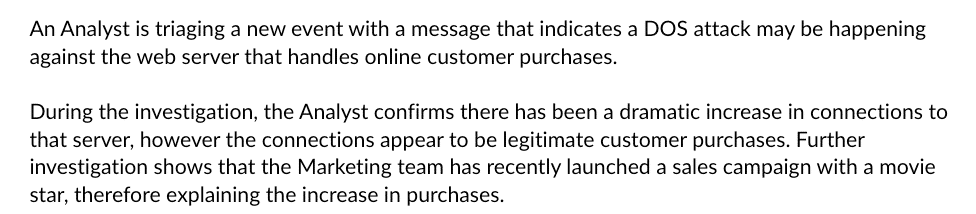
2. With the provided context, what disposition would you assign to this event?
- False Positive
- True Positive
A False Positive occurs when an alert indicates suspicious or malicious activity, but investigation reveals that the activity is actually legitimate.
In this scenario:
- The alert suggested a DoS attack due to a dramatic increase in connections.
- The analyst investigated and found that the connections were legitimate customer purchases.
- The increase was caused by a marketing campaign with a movie star, not by malicious activity.
Since the alert was triggered but no actual attack occurred, the correct disposition is:
✅ False Positive.
3. Which of the following are elements of Cybersecurity Operations? (Choose all that apply)
- Policies and regulations
- Processes
- People
- Technologies
Cybersecurity Operations relies on four key elements:
- People – Security analysts, engineers, architects, managers, and other personnel.
- Processes – Procedures, workflows, incident response plans, and operational practices.
- Technologies – Security tools, SIEMs, firewalls, EDRs, and monitoring systems.
- Policies and Regulations – Organizational policies and compliance requirements that guide security operations.
Correct Answers: ✅ Policies and regulations, ✅ Processes, ✅ People, ✅ Technologies.
4. The Security Posture of an organization represents how well an organization can predict, prevent and ___respond______ to ever-changing cyber threats.
A strong security posture enables an organization to:
- Predict potential threats and vulnerabilities
- Prevent attacks through controls and defenses
- Respond effectively when incidents occur
Correct Answer: ✅ Respond.
5. Match the SOC metric with what it measures:
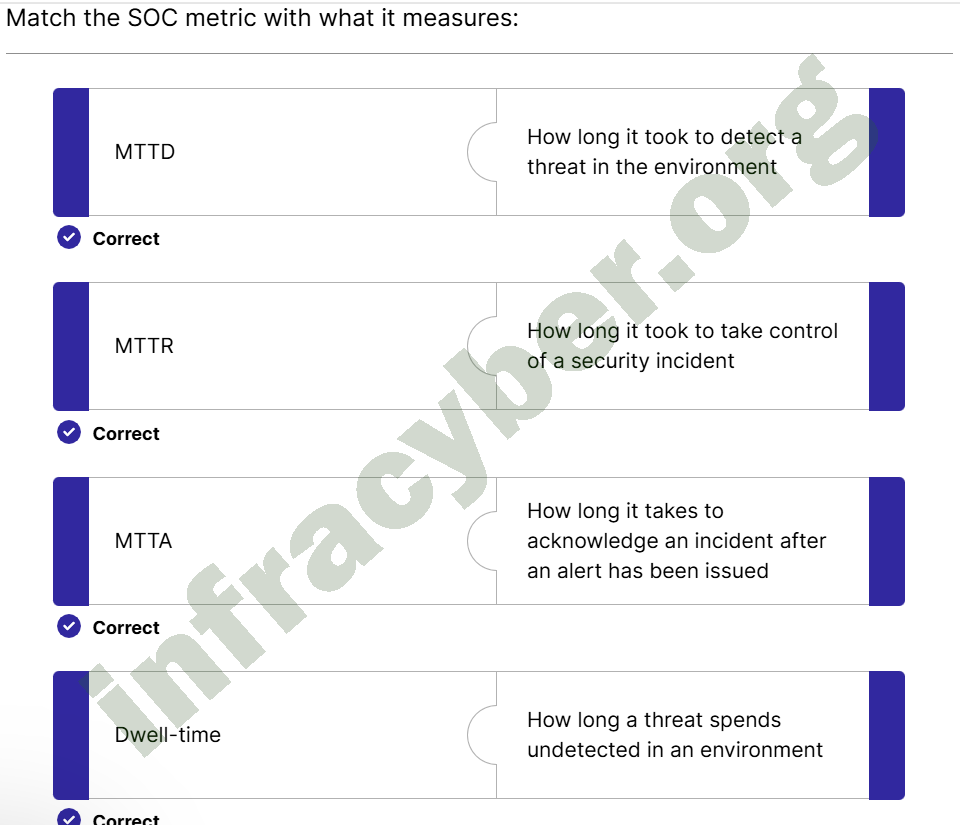
- MTTD → How long it took to detect a threat in the environment
- MTTA → How long it takes to acknowledge an incident after an alert has been issued
- Dwell-time → How long a threat spends undetected in an environment
- MTTR → How long it took to take control of a security incident
6. Which stages of the Continuous Monitoring cycle is the Cybersecurity Defense Analyst primarily associated with?
- Define and predict
- Implement and collect
- Analyze and report
- Establish and architect
- Respond and review
✅ Analyze and Report
- Investigate alerts and notable events
- Perform threat hunting
- Analyze security data
- Document findings
✅ Respond and Review
- Support incident response activities
- Contain and remediate threats
- Conduct post-incident reviews
- Improve detections and processes based on lessons learned
7. Threat Hunting is a human-centric process that begins with a _______ ?
- Alert
- Notable Event
- Hypothesis
Threat Hunting is a human-driven, proactive process that starts with a hypothesis about potential malicious activity in an environment.
Example hypotheses:
- “An attacker may be using PowerShell for lateral movement.”
- “A compromised account may be accessing sensitive data after hours.”
The hunter then searches available data sources to prove or disprove the hypothesis.
Why the others are incorrect:
- ❌ Alert – Reactive security monitoring typically begins with an alert.
- ❌ Notable Event – A notable event is usually generated by a SIEM and investigated by analysts.
- ✅ Hypothesis – The starting point of proactive threat hunting.
Final Answer: ✅ Hypothesis.
8. What are other non-primary but important tasks that Cybersecurity Defense Analysts can perform to help improve Security Operations? (Select 3)
- Share suggestions for automation and improved remediation steps
- Select protection tools that will be used in the organization
- Get data, assets and identities into Splunk
- Provide detailed documentation in their reports and notes for other teams and analysts
- Request improvements and the development of dashboards, searches and tooling
While the primary role of a Cybersecurity Defense Analyst is to monitor, investigate, and report security incidents, they also contribute to improving security operations by:
- Recommending automation opportunities and better remediation processes.
- Creating detailed documentation that helps future investigations and knowledge sharing.
- Suggesting improvements to dashboards, searches, detections, and security tools.
Incorrect Options
- ❌ Select protection tools that will be used in the organization
This is typically the responsibility of Architects, Engineers, or Security Leadership. - ❌ Get data, assets and identities into Splunk
This is generally performed by Engineers and administrators responsible for onboarding data sources.
Final Answers:
✅ Share suggestions for automation and improved remediation steps
✅ Provide detailed documentation in their reports and notes for other teams and analysts
✅ Request improvements and the development of dashboards, searches and tooling
9. Which metric could help identify each of the following issues?
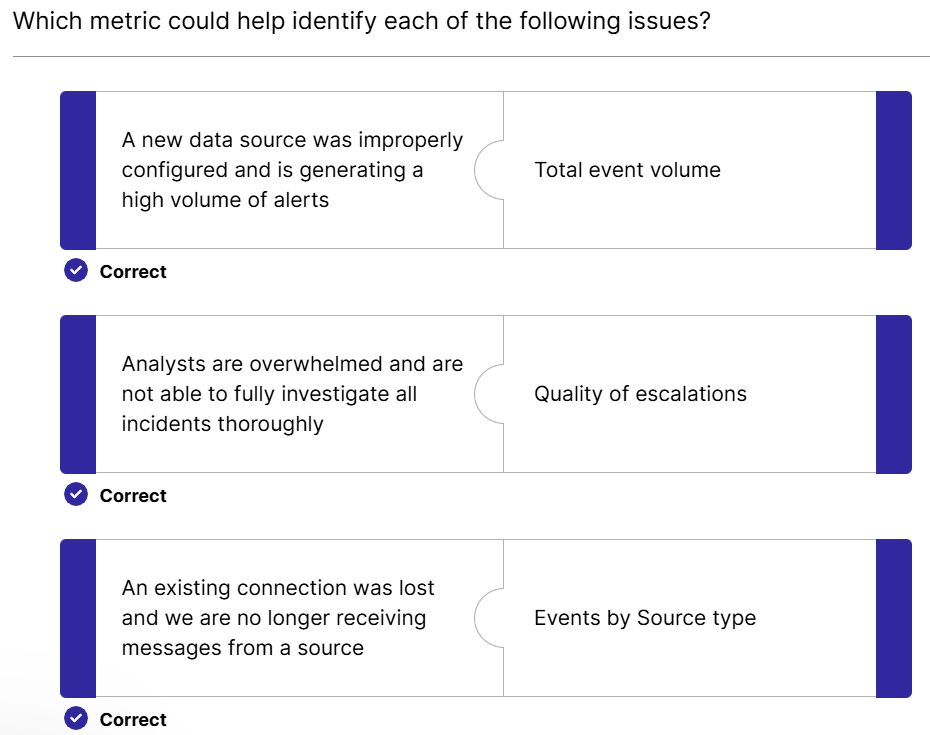
- Total event volume helps identify unusual spikes in events or alerts, often caused by misconfigured data sources.
- Quality of escalations can reveal whether analysts are rushing investigations due to excessive workload.
- Events by Source type helps monitor data ingestion and can quickly show when a log source has stopped sending events.
Final Answers
- A new data source was improperly configured and is generating a high volume of alerts → Total event volume ✅
- Analysts are overwhelmed and are not able to fully investigate all incidents thoroughly → Quality of escalations ✅
- An existing connection was lost and we are no longer receiving messages from a source → Events by Source type ✅
10. With the provided context, what disposition would you assign to this event?

- False Positive
- True Positive
In this scenario:
- The alert indicates authentication errors exceeded for user ST002.
- The analyst investigates and finds evidence of a dictionary attack attempting to gain access to the account.
- A dictionary attack is a real malicious activity and a recognized credential access technique.
Since the alert correctly identified suspicious behavior and the investigation confirmed an actual attack attempt, the event is a:
✅ True Positive.
11. Match the SOC role with the activity they will most likely be responsible for, according to Splunk’s Blue Team Academy definitions:
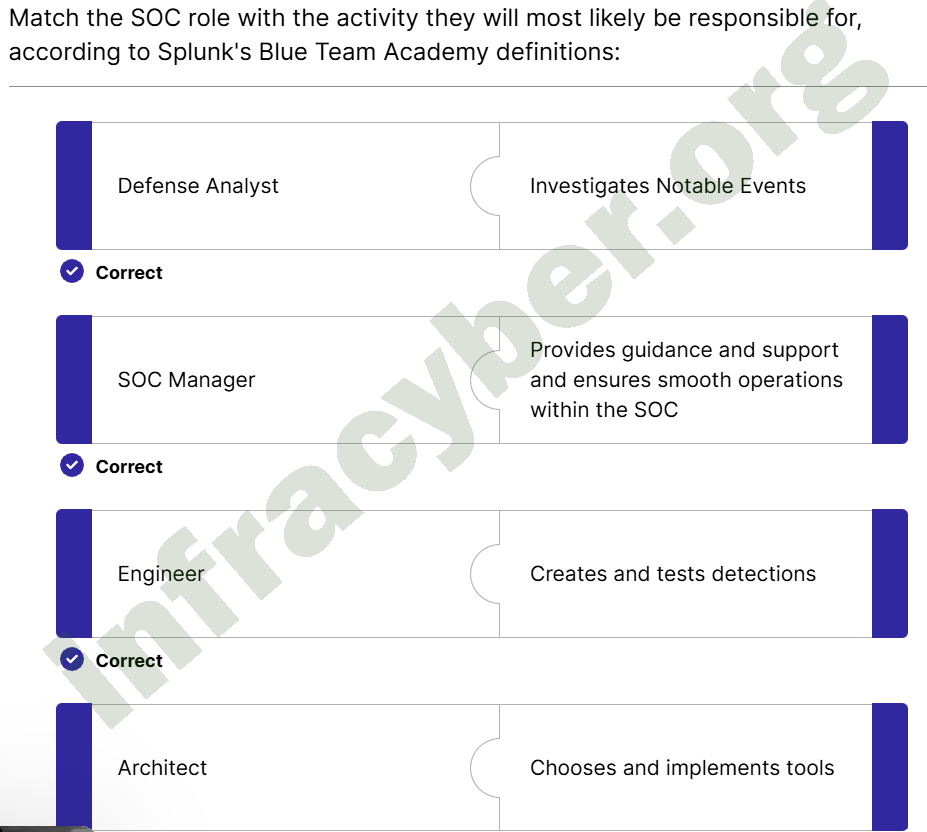
- Defense Analyst ==> Investigates Notable Events
- SOC Manager ==> Provides guidance and support and ensures smooth operations within the SOC
- Engineer ==> Creates and tests detections
- Architect ==> Chooses and implements tools
12. According to the Blue Team Academy definitions, which of these activities are performed more often by the Cybersecurity Defense Analyst in a SOC? (Select 2)
- Alert triage
- Threat hunting
- Creating new detection rules
- Ensuring data is brought to the corresponding SIEM
According to Splunk Blue Team Academy, Cybersecurity Defense Analysts primarily focus on:
- Alert triage – Reviewing, validating, and prioritizing security alerts.
- Threat hunting – Proactively searching for threats that may not have triggered alerts.
Why the others are incorrect:
- ❌ Creating new detection rules – More commonly performed by Security Engineers.
- ❌ Ensuring data is brought to the corresponding SIEM – Typically the responsibility of Engineers and platform administrators who manage data onboarding.
Final Answers: ✅ Alert triage and ✅ Threat hunting.